
 Review by Tessara Dudley
Women In Marigold is a book of poems that explore the smallest moments of life with lush imagery and evocative metaphor. This collection is playful and serious by turns, but earnest and real throughout. Each poem both stands alone and links to those around it. Taken together, they reveal the many quiet stories of everyday life.
The poems in this collection are arranged into three sections. The first ruminates on locations—physical and metaphorical—and what makes a home. “PERMIT YOURSELF ANGER” points to the limbo of diaspora: “They won’t go back but they want Nepal / to shift into a shape they might return to” (3). Immigration, diaspora, and displacement are examined from many angles, with the speaker living in the tension between literal location and metaphysical home. In “LOCATION,” a Bhutanese grandmother refuses resettlement in America, dying of heartsickness before leaving home. In “NAKEDNESS IS A TRUTH, NOT THE TRUTH,” the speaker visits the capital city of Nepal and muses “Can I be / in two places at once? Who am I kidding. It bends to an inherent / contradiction” (19).
Section two is focused on rituals and traditions, both formal and informal. The section opens with a sequence of poems that examine the tiny rituals families can make of their weekends. Small moments of connection between mother and daughter become all-encompassing and vital, especially upon later reflection: “Seven thousand miles away, now / when we argue over video calls, Aama can’t come and hug me” (33). From there, the speaker moves to cultural traditions, both positive and negative. The poem “IN RUPANDEHI, A TWELVE-YEAR-OLD GIRL HANGS IN THE MANGO TREE” presents two real-life stories of caste-based violence where young people lost their lives. The section ends with a poem about homesickness during a holiday the speaker cannot celebrate in another country. In conversation, these poems show that even when home is not a perfect place, the yearning for that home carries on, especially when ritual and tradition are interrupted by distance, and even when some traditions are complicated or painful.
The third section speaks of transitions and passages: birthing, puberty, marriage, aging, death. The poem “DOLL-HOUSE” reflects on the birthing process and the eventual passing of a mother: the life cycle. “THERE ARE MANY WAYS OF BEING HELD” focuses on a bride experiencing doubts shortly before her wedding, as she prepares for the transition from her childhood home to her new home as a married woman. Other poems reflect on personal loss as well as national and international tragedy from natural disasters. Here, the speaker must confront the reality of aging and the eventual loss of family members to the passage of time:
Hajurama is waiting for your call and you are ashamed
of wanting to write instead. “You just need to pick up the phone
and call,” they say. But that’s not true before that you have to accept
you are a thousand miles away from her and she is getting old. (78)
Each of the three sections contains seeds of the others, giving the whole collection a pleasing throughline, while also standing on their own as meditations on specific themes. Like a puzzle, the poems come together to form a wider picture, one of immigrant and refugee life, and of different generations finding their way through the world.
The poems in this book are filled with many cultural words, left untranslated. Some of them are clear by context, but many are not. I found myself pausing to look up these words, but this is not a bad thing; rather, it slowed down the reading, and required me as a reader to take the poet where she is at, to locate myself where the poems are located, which is mostly outside my own experience. This is a collection to meditate on and return to, poignant and vital in the current political climate, specific in experience but with a universality that I believe will stand the test of time as well.
Mansi Dahal is a writer from Biratnagar, Nepal. A graduate of Columbia University’s MFA program, she is the recipient of the Waletzky Fellowship from their School of Arts, as well as a finalist for Palette Poetry’s 2022 Sappho Prize, and a fellow in the Poets & Writers 2026 “Get the Word Out” program. She has served as the editor-in-chief of Some Kind Of Opening and splits her time between New York and Nepal. Women In Marigold is her debut poetry book.
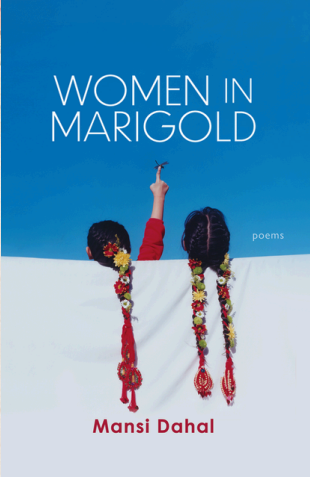
Women in Marigold by Mansi Dahal
Stillhouse Press, 2026, 97, $18.00 [paper],
ISBN 9781945233340
Tessara Dudley has published poetry in Sun Star Review, Wordgathering, Lothlorien Poetry Journal, #EnbyLife Journal and Soul Poetry, Prose & Arts Magazine, and in anthologies published by Minerva Rising, Zoetic Press, Damaged Goods Press, and Wingless Dreamer. They are the author of Fallen/Forever Rising, and are currently working on their second poetry book, a collection of sapphic reimaginings of fairy tales, folklore, and myths. Tessara shares poems, writing resources, and book reviews at http://tessaradudley.substack.com