
 Review by Jessica de Koninck
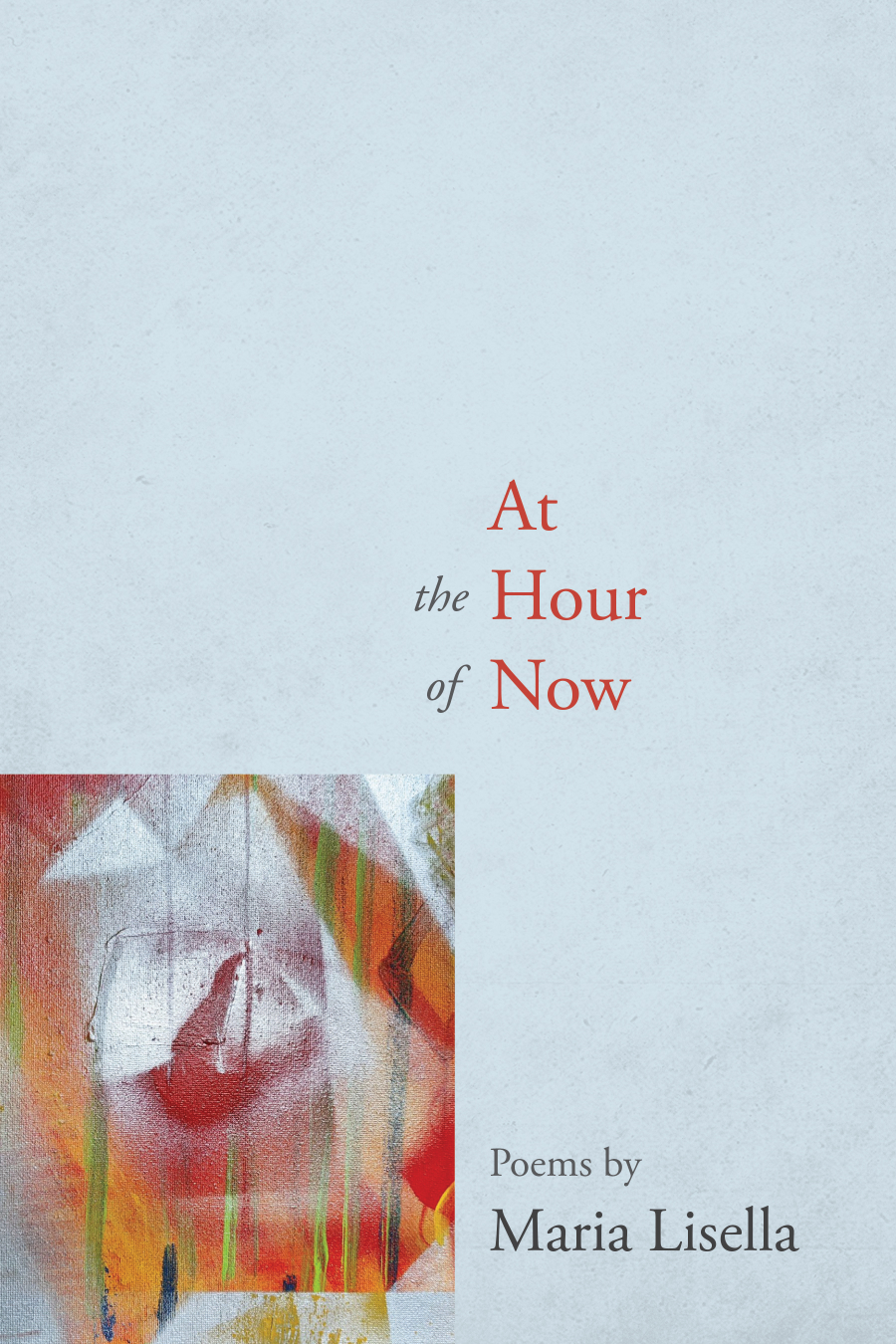
When my husband died a friend of his who had also lost a spouse said to me, You will find you become the other person. True. I began to see things, to hear things the way my husband would have seen or heard them. In her beautifully felt collection, At the Hour of Now (Bordighera Press, 2026), Maria Lisella, former Queens poet laureate and author of three previous collections, “becomes” her late spouse.
Like the small family of three the poems depict, the collection is divided into three sections. In those poems the poet “becomes” not only her spouse, the poet, translator, essayist and short story writer, Gil Fagiani, but her co-survivor, her blind mentally ill stepson. Mixing grief and love, Lisella blends their poems with her own into a collection that is both part elegy and part memoir. That explicit use of three voices is an interesting editorial decision and allows for varied points of view in these largely narrative poems.
In the collection’s first section, “Somebody’s Child,” the reader meets stepson, Mario Fagiani. The speaker imagines a more contented life for him in the opening poem, “What I’d Wish for You.” But in “Bronx Boom Box” the speaker creates distance. Yet the poet’s love, along with her desire to protect, flows from every poem, as in these last two stanzas of, “Our Date:”
I think of all I don’t know
about courage—how to build it,
pass it on, when to fight, to flee,
and when to leave your bike
behind, save your life,
find your way home.
Gil Fagiani’s prose poems round out Mario’s story. Gil quotes a conversation with Mario in “At the Hospital,”
“I’ll be right back,” I say, heading toward the nursing station to speak with
a psychiatrist. “Don’t talk to the doctor,” my son shouts. “Don’t talk
to the friggin’ doctor. You’re the reason I can never get out of here.”
Lisella’s poems in this section focus on the poet’s role as stepmother and observer. In “Seeing for Him,” she describes Mario’s room to him. But, the speaker remains stepmother, both close and distant.
I cook what I can—but even now,
he waits for his real mamma to feed him.
By choosing Mario’s poems, Lisella deftly permits him to use his own voice, completing the family trio. The longest poem in the section, “A Slice of Life,” belongs to Mario. Its hip-hop rhythm makes clear the piece is intended to be spoken.
The second section of the collection is its heart, laser focused on the beloved spouse. The section’s title, “Mercy,” more fairness than pity, but also gratitude as in the French, merci, thanks. In chronological fashion the poems explore end of life and after. The opening two poems are Gil’s, hospitalized and in treatment for cancer.
Most of the poems in this section, however, are Lisella’s. In “Anointing” the poet makes a sad, surreal hospital, and the scene zooms in on her lovingly washing her husband’s face and the childhood memories invoked. “Knowing When to Leave,” another poem set in the hospital, creates a claustrophobic sense of stopped time. Then the poet must move on to what happens after.
The stepson is largely absent from this central section of the collection until the death of the husband:
We followed the arc of what we came for
beyond anything we could ever know.
Your staggering belief mystifies me: that you
will see me over and over again, guide me
to the next rung of love, life, and the first
spring without you. (“Anniversary”)
After that death, the stepson becomes the responsibility of the speaker:
Perhaps it was the stun of her matter-of-fact tone when my tiny
acupuncturist expressed no sympathy or solace when I reported
my stepson’s last suicide attempt. She said: Why did you save him? In my
country we would have let him go because he wants to die. What kind of life
will he have? (“When It’s Just About Hope”)
The final section of the collection is brief and meditative comprised of four poems, one an ekphrastic sonnet, one a haibun. The future will be different, not easy, but not alone.
At the Hour of Now by Maria Lisella
Bordighera Press, 2026, 95 Pages, $
ISBN 9781599542485
Jessica de Koninck is the author of Repairs (Finishing Line Press) and Cutting Room (Terrapin Books) with her collection My Grandmother Talked to Dolls forthcoming from High Frequency Press. Her work has been featured on The Writer’s Almanac and Verse Daily. www.jessicadekoninck.com