
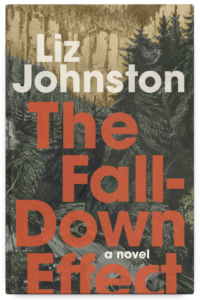
 Review by Jane Ward
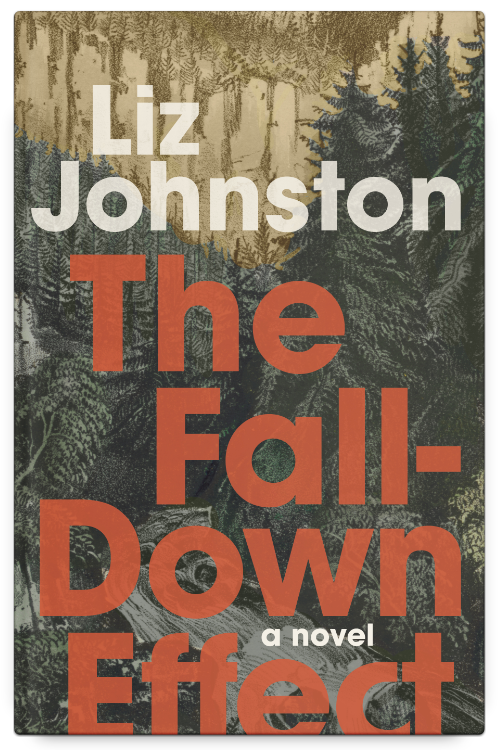
It was fitting to begin reading The Fall-Down Effect, Liz Johnston’s forceful debut novel featuring a family unraveling amid environmental crisis, at the tail end of a summer that saw much of the world baking and a wide swath of Canadian wilderness burning out of control. This was the second summer in a row that I took note of the smoke and haze of these fires drifting down and across the northern United States. The pervasive smell and particulate matter couldn’t avoided.
The Fall-Down Effect shows us that these circumstances should not be ignored.
The novel opens in 1989 in remote British Columbia. Siblings Sylvia, Fern, and River are homeschooled by their mother, Lynn, and have the run of the surrounding forest as their classroom. Their father, Tom, is a park ranger, also immersed in the land he cares for. The pair had been climate activists in college, protesting the clear cutting of forests before a tragic event caused Tom to drop out. Lynn, however, refuses to bend from her beliefs. Their home is located within a logging and lumber mill community at odds with these, and when Lynn chains herself and her three young children together to block a new logging road, she is seen as a danger to everyone from her children to the local economy. Casting herself as an outsider who wants more meaning from life, Lynn leaves Tom and the children.
River is too young to be anything but scared and upset. In Sylvia, we see the beginnings of resentment for her mother’s lack of involvement with them. But it is the middle child, Fern, who takes her mother’s passions to heart.
Fern felt powerful chained there in front of the line of trucks with
their ground-quaking rumble and diesel reek. She called out Mom’s
chants louder than River and Sylvia combined…. (28)
Her beliefs, like her mother’s, are black and white—stripping the forests is bad, making a living from this work is bad, and taking direct action to stop the destruction is good and necessary. When the novel next picks up in 2001, Fern has joined her mother and her mother’s new partner at a protest. There, she comes under the sway of a radical group of environmentalists. Before joining them, though, she commits an act of violence in her community that brands her as an ecoterrorist and then a fugitive.
Finally, she’d done something real, something that counted. And
now that the initial terror was wearing off, now that she wasn’t
just feeling but heading somewhere, now, at last, she could breathe
deeply. (121)
The final section opens in 2020 during raging wildfires and a global pandemic. Lynn and her partner, Irene, must evacuate from an encroaching fire, and they ask to stay with Tom and his new partner, Jan. Uneasily reunited, this divided family must reckon with past decisions and the uncertainty of how—or if—relationships might heal. Fern has long left the ecoterrorist group and is living on a wildlife preserve across the border in the US. In a vulnerable moment, she messages her younger brother, River, through an acquaintance’s Facebook page, and their tenuous reconnection creates the possibility for reunion.
The novel’s title comes from an accepted corollary of logging. Once old-growth forests are completely felled for timber, harvesters must turn to newer plantings. These second-growth forests contain fewer and smaller trees, meaning the yield will be lower—the consequence is a “fall down” in supply. So much of this engrossing story is about consequences, both personal and global. What happens when ardent public commitment leads to an act that puts one’s beloved family at risk? Can there never be a balance between protecting the land and protecting a community? And what meaning can one find after protest movements seem to have little effect on outcome?
Thirty-one years on from the opening of the story, neither the protests nor the more radical actions have slowed the devastation. If anything, climate crisis is escalating. There are no answers or platitudes on offer here. Johnston lets us sit with our questions about consequence and our unease at the state of the world. But we are left with Fern’s contemplation of one day seeing her brother again.
An idea caught her mind passing the postcard display on her
way back out. She pulled out a card: a sweeping view of the preserve…
On the back of the postcard, along the top edge, the name of the
preserve was printed in small type. (336)
And perhaps on a burning planet this is our hope: making connection, one hand outstretched to another.
The Fall-Down Effect by Liz Johnston
Book*Hug Press, April 21, 2026
Trade Paperback $24.95
ISBN 9781771669627
Jane Alessandrini Ward is the author of Should Have Told You Sooner (She Writes Press, 2026), In the Aftermath (She Writes Press, 2021), The Mosaic Artist (2011) and Hunger (Forge, 2001). She has been a contributing writer for an online regional and seasonal food magazine and a blogger and occasional host of cooking videos for an internet recipe resource. Jane lives in Massachusetts. To learn more, visit janeaward.com.