
 Review by Emily Hall
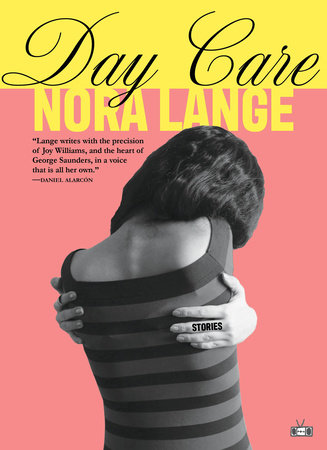
Nora Lange’s short-story collection, Day Care, is a piercing exploration of womanhood and fulfillment. The follow-up to her debut novel, Us Fools, the eighteen stories in this collection center on women who feel unsatisfied and neglected, despite having partners and/or children. While many writers have explored the hollow promise of domesticity, Lange brings fresh perspective to this, as she illustrates how women use fantasies and daydreams to regain their sense of fulfillment.
Although the characters in these stories face mundane challenges, like neglectful partners and overbearing mothers, Lange amplifies the tension by infusing these conflicts with surrealistic elements. Such is the case in “Owls Yawn, Too” a story about an older woman named Connie, who has to work a “nameless job” to support her family (140). Her only sense of joy is an owl that occasionally visits her house, and whose presence makes her feel “invigorated” and “primal” (139). These feelings stand in contrast to Connie’s otherwise suppressed emotions. Even when her daughters insist that she’s merely imagining the owl, Connie continues to daydream about him, proof that she craves the freedom he embodies.
While several stories like “Owls Yawn, Too” and “Panel vs. Board” explore women’s unfulfilling careers, the strongest stories illuminate the toll of caretaking. In “Last Boob Feed,” for instance, a new mother imagines “lightly scrambling” eggs for breakfast. Too tired to cook, she fantasizes about this breakfast, while her husband capably makes himself “an everything bagel” lavishly topped with even more “everything-bagel seasoning” (21). Because he never stops to ask if she’s hungry, she can only dream of nourishment. Like many of the female characters in Day Care, the protagonist of “Last Boob Feed” doesn’t have a name, a sign that she’s lost her identity. At the same time, her namelessness gestures to the ubiquity of her experience as a woman whose needs are overlooked.
Lange further explores caretaking in “Letting Snails Go,” albeit outside the context of motherhood. Many of the stories in Day Care are told in a deadpan, if not icy, voice that may distance some readers from their characters’ struggles; however, “Letting Snails Go” is an exception to this. The heart-wrenching story focuses on a woman crushed by responsibility. Birdy’s the sole caretaker for her ailing father, and her support system is nonexistent. When she begrudgingly attends her high school reunion, she finds her old flame, JP, and they fool around in the bathroom. Lange hints, however, that Birdy may be imagining their interaction. In the midst of their odd, but intimate encounter, Birdy sees the phrase “Is this reality?” scrawled across a stall (90). At first, this question suggests that Birdy has conjured up JP. But this question of reality resurfaces a few times throughout the collection, as if to suggest that many women are bewildered by how their lives have unfolded.
As these stories demonstrate, Lange suggests that women need fantasies because there are too many obstacles in the way of actual fulfillment. She thus satirizes the belief that women, especially mothers, can have it all. Some characters, though, try to fight this inevitability. For instance, in the darkly funny “Dog Star,” a teenage girl worries that she’ll eventually turn into her mother. Realizing that “girls were girls until they were mothers,” and that she has few paths out of her world, the unnamed protagonist and her friend, Alice, imagine turning into octopuses so they can wriggle away from the confines of womanhood (69).
Meanwhile, in the titular story, “Day Care,” a single mother tries to make time for herself. Newly separated from her husband, the protagonist spends her days “presenting her needs completely yet concisely” on online dating forums (159). Hoping to care for herself by acting out her sexual fantasies with strangers, the protagonist tries, and fails, to arrange her own “daycare,” while her infant daughter is watched by others. The story is ironic and funny, but also bleak. When the protagonist’s husband tries to lure her back home, she’s aware that his pleas lack sentiment, but the promise of any kind of support make her feel hope. With remarkable complexity, Lange frames the protagonist’s compromise as both understandable and sad.
While this collection satirizes weightier subjects, it’s nevertheless buoyed by its wry humor and Lange’s sharp eye. Ultimately, Day Care is a satisfying exploration of desire and fulfillment. These stories will linger long after readers have finished them, if only because they’re reminders that women deserve so much more.
Day Care by Nora Lange
Two Dollar Radio, 2026, 200 pages, $17.95
ISBN: 9781953387578
Emily Hall has a PhD in contemporary Anglophone fiction from the University of North Carolina at Greensboro, and she’s a prose editor for Pictura Journal. Her reviews have appeared in Portland Review, Necessary Fiction, MER, Washington Independent Review of Books and Heavy Feather Review. Her creative prose can be found in places such as Gooseberry Pie Lit, 100 Word Story, Passages North, and Blood Orange Review, and The Disappointed Housewife.