
 Review by DeMisty D. Bellinger
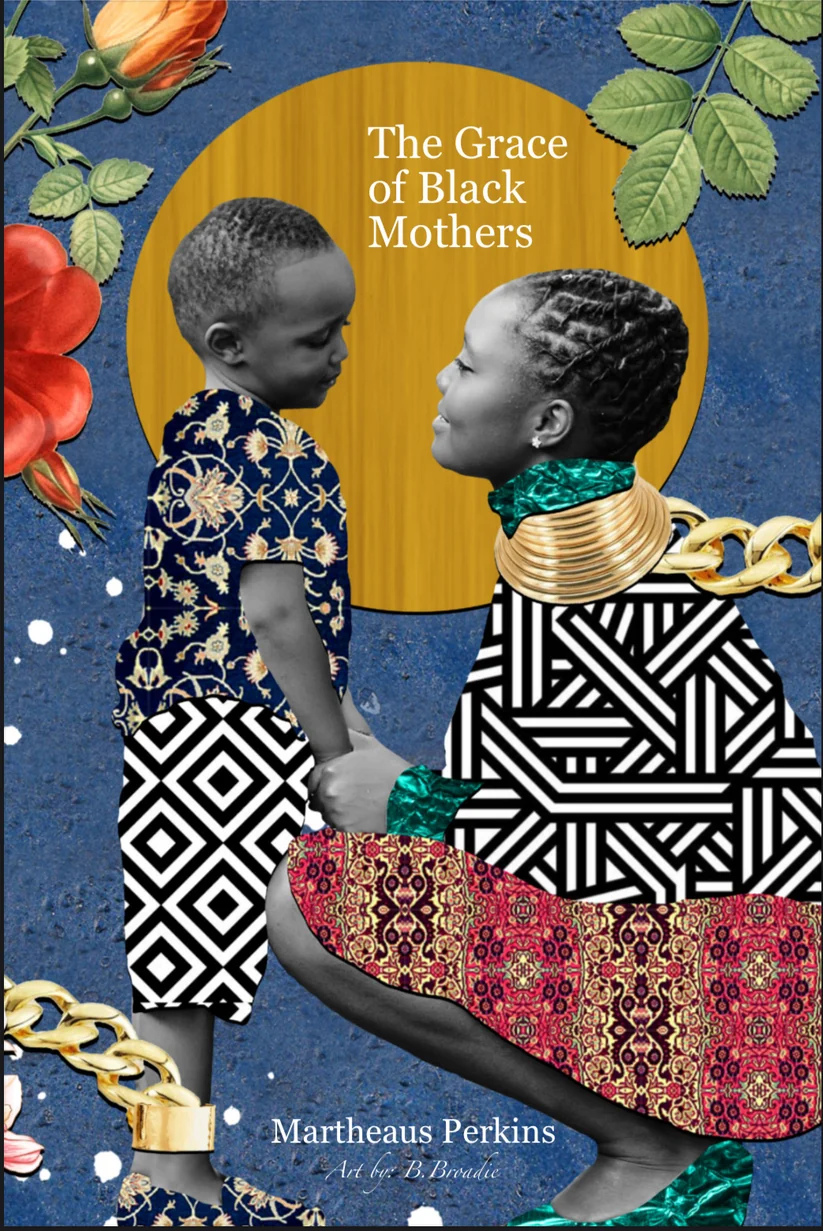
Martheaus Perkins’ The Grace of Black Mothers is an honest and loving homage to the women who raised him, including his mother who lived a fully American life. Perkins also commemorates victims of state violence in the African-American community and their mothers. There are lots of hermit crab poems—a form which takes on the format of other writings—and there also are family photographs which are presented as poetic lines themselves. With his debut poetry collection, Perkins enters not only the ongoing conversation among poets and pundits, but with his family, his communities, and the greater amorphous Black community.
Perkins is a young professor in Virginia, where he specializes in hip-hop as literature, the Black Superhero, Shakespeare, and the Harlem Renaissance, almost all of which show up in this collection. Born in Texas, he was raised by a single mother who got pregnant during her first year of college.
The book is broken into three aesthetically thoughtful acts: “Coup de Grâce,” “Airs & Graces,” and “Saving Grace.”
The first poem is “Family Album,” in which a picture of his mother and grandmother, both beautiful women with ebony hair, stand embracing. The last four lines are poem enough alone:
They’ve never looked more
Like mother and daughter,
both too young. Both smile
at a future they would not want.
These are everyday words made powerful by the rhythm Perkins create and weighty in meaning. This first poem perfectly sets the scene for the collection.
“Scene from a Center, Texas Walmart,” is true to the structure of the book as a kind of play in three acts. In the format of a short play, the poem describes a painful situation where the speaker’s mother is questioned about her baby’s origins. His light-colored confuses people, including the cashier who the mother knows, because they do not know his father is white. Later, a character called Old Ass Lady coos at the baby: “He is the sweetest little thang. Whose is he?” When the mother says that the baby is hers, Old Ass Lady argues, “No, no, this baby can’t be yours, sweetie. He’s white.” Old Ass Lady’s disbelief does not change. This witty play/poem shows Perkins’ ability of storytelling and in poetry.
Each one of Perkins’ poems could be read aloud, even the poems that append images or employ concrete elements, but some of the poems play with space and format work so well, they cannot be imagined any other way. For instance, “Captions for Pictures Lost in Storage” are only captions beneath empty spaces, depicting missing pictures but, somehow, holding on to what was there. This multi-paged poem feels like incomplete memories, snapshots in words.
Act II of the book brings in more of the speaker’s father, the absent white man who impregnated the speaker’s mother during a one-night stand. It also brings in more hermit crab poems, including quizzes, an annotated poem draft with “end notes,” a Venn diagram, TV show listings, and more. Perkins’ love of super heroes and comics appear in the poem “Which Batman Villain Is Your Deadbeat Dad?” which is pretty self-explanatory, but each question in the multiple choice quiz offers italicized text that obviously refers to the speaker’s dad. It’s an internet quiz. One of the comments is from BlackMom19 who tells the speaker, or “AccidentSon,” “You need to delete this, sweetie” and “It wasn’t like this. We were both drunk.”
Call and responses, memorials, and joy fill the pages of Act III. Though it happens throughout the book, it is in Act III where Perkins offers solace to all Black mothers, but especially those who lost their children to violence. One of my favorite poems of the collection is the penultimate poem, “Center, Texas.” It begins with the speaker’s grandmother, Ne Ne, bringing him and his mother into her home, saving them from homelessness. Rich with imagery, you can smell the result of hoarding and feel the result of neglect*. Beautifully written, but messy as the kitchen they clean, and I can’t tell, reading after reading, whose home is falling apart.
This book offered me a kinship with these mothers. I feel I know the women Perkins offers such grace to, as well as the son who looks for definition without a father figure. The Grace of Black Mothers is smart, beautiful, forgiving, honest, and loving. I look forward to more from Perkins!
The Grace of Black Mothers by Martheaus Perkins
Trio House Press, 2025, $18 USD
9781949487428
DeMisty D. Bellinger teaches creative writing and African-American Studies at Fitchburg State University. Her latest book is All Daughters Are Awesome Everywhere. Find her at demistybellinger.com.
* This reviewer’s parents had a clean-out business for years. She is very much aware of the smell in some hoarders’ homes!