
 Review by Sharon Tracey
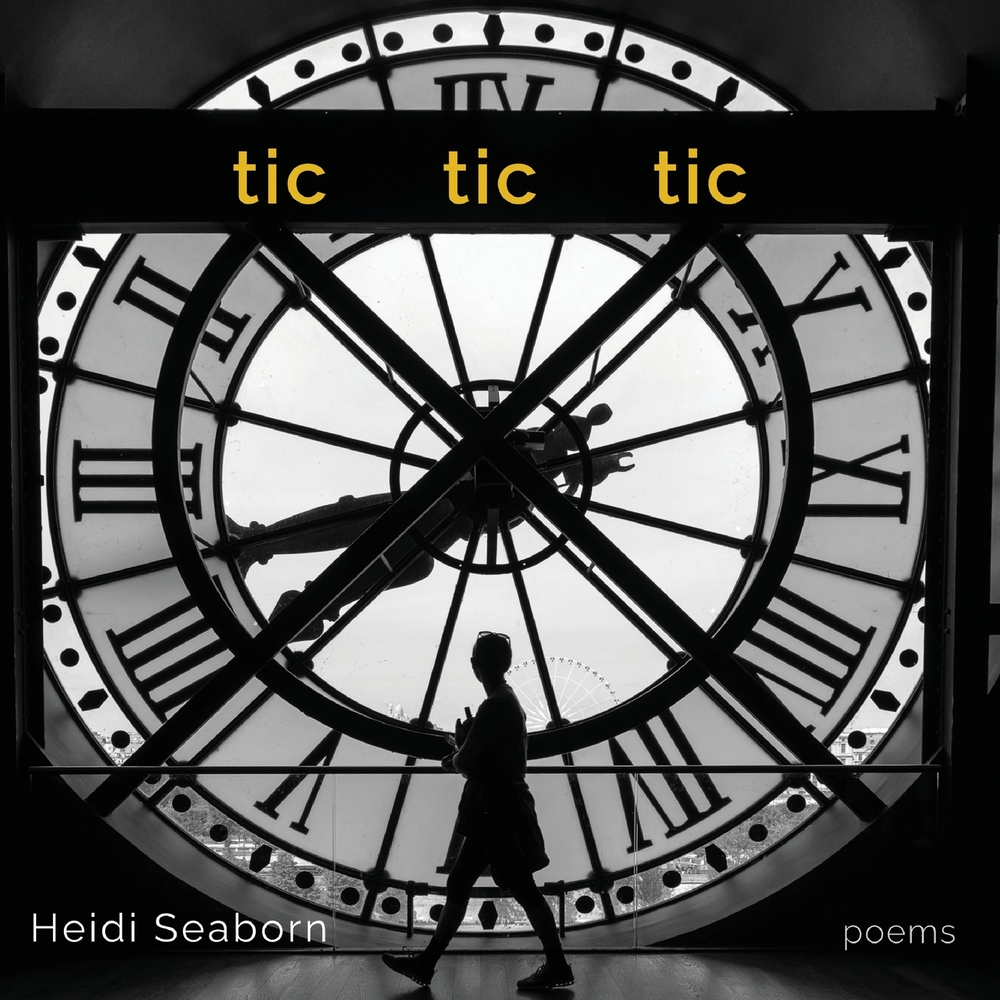
In tic, tic, tic, poet Heidi Seaborn unwinds and fast forwards a time capsule of poems that freeze and free, set within a swirl of personal, political, and moral questions of our time. Seaborn is also the author of two other books and three chapbooks, and the executive editor of The Adroit Journal.
The evocative title sets the mood—tic, tic, tic—an impulse, a pulse, a twitch, a nerve that awakens and stirs emotions and memories. Seaborn’s overarching subject is Time—living in it and through it, and looking back once it’s passed by us. Her poems take up personal and family history, lockdowns, pandemic parades, the storming of the capital, elections, exiled kings, protests, and wildfires, among others, and ask the questions any of us might ask of ourselves—what do we make of our lives and how will we leave our imprint?
Arranged in four seasonal sections, the book opens with Winter and concludes with Autumn as Seaborn weaves the personal and the political in a way that preserves both the warp and weft like a well-knit sweater. In Winter, there are poems date stamped by year and season, conjuring a freeze frame of sorts as in “Winter/Spring 2020” (p 7) where the poet, writing of pandemic time, reflects:
…
We all know someone, we said. You or you or the other.
Immune sounds like commune but it’s not the same.
I had not though death had undone so many wrote Eliot. On a walk—
the parade I join twice daily, faces cloistered—
bright eyes, bright eyes. Following the river of death downstream.
…
And then post-pandemic there’s “7 October 2023” and the poet’s thoughts in the middle of her son’s wedding (p 17) as she writes:
My son’s wedding—
vows beneath a California oak, vineyards marching
the hills, a fiery sunset.
I missed the news
of the cross-border attack—
I was dancing
someone hoisted a chair—
even as elsewhere, another morning was waking—
to carnage
…
In Spring, most of the poems appear as time capsules—each a vignette that visually reads almost like a postcard poem, each sketching a world in words, date stamped and jumping years across time, from “Tax Return, 1958” to Family Wedding Photo, 2023” before a single jump backwards to “Photos of Sunsets, 1984-” with its open-ended hyphen, perhaps a nod to time’s fluidity.
Summer includes the four-part poem “Lookout,” in dialogue with T.S. Eliot’s Four Quartets. There’s “Skagit Valley,” “Into the Garden,” “Puget Sound,” and “Feverish,” the latter a poem in which the poet teeters on the edge of despair in the face of global environmental devastation—extreme heat, wildfires, hurricanes, floods—as she writes (p 68):
…
What good does it do to kneel—
before that destructive fire? To write the sins as if wringing the oil from a rag—
before flicking the flame? Am I not praying—
for a beginning while flecked with ashes from the end?
Then comes the poem “UNENDING” (p 69) whose structure evokes a series of boxes or stepping stones, with four long lines, interspersed with seven short columnar lines, as if leaving space for a reader’s own thoughts (p 69) as the poet begins:
All morning the brown birds in the tree noise & bother over a nest. When I find
the folded form of dirt
brown bird on the drive
later I reach
for morning as if
it were a line thrown
from a dock
but I am drifting—
the bird chirp snagged in the wind of ticking hours. The end of the day—will not
end its spiral
descent to
another place—
call it a life or a death.
…
There is a sense of collage running through the collection with more than twenty black and white photographs included. Could the poems stand on their own without the photographs? Yes, which speaks to their strength and variety, and yet, the collection would lose some of its photo-album, scrapbook, hand-held memory-palace feeling without them.
The final section, Autumn, is composed of a single page poem, “TAKE FIVE” (p 91) as Seaborn begins:
The tempo changes. Rain in late August.
Wildfire season extinguished.
As my email clutters with democratic emergencies, I play
Brubeck’s Take Five on loop like when I was seventeen
driving through green, green, green. Untarnished by sunlight.
Listen to the drum solo. An enjambment.
Off-kilter. Giddy. Like love.
Yes, let’s say it’s love.
…
A final section with a single poem was a surprise, but then isn’t this like Time itself, always running out, becoming unpredictable, yet hopeful? And it feels fitting as Seaborn’s tic, tic, tic—in spite of our chaotic times—feels hopeful and a collection to return to.
tic, tic, tic by Heidi Seaborn
Cornerstone Press 2025, $23.25 [paperback]
ISBN: 978-1-968148-07-2
Sharon Tracey is the author of three collections of poetry: Land Marks (Shanti Arts 2022), Chroma: Five Centuries of Women Artists (Shanti Arts 2020), and What I Remember Most is Everything (All Caps Publishing 2017). Her work has been published in Calyx, Radar Poetry, Terrain, and The Ekphrastic Review, among other journals and anthologies. More at sharontracey.com.