
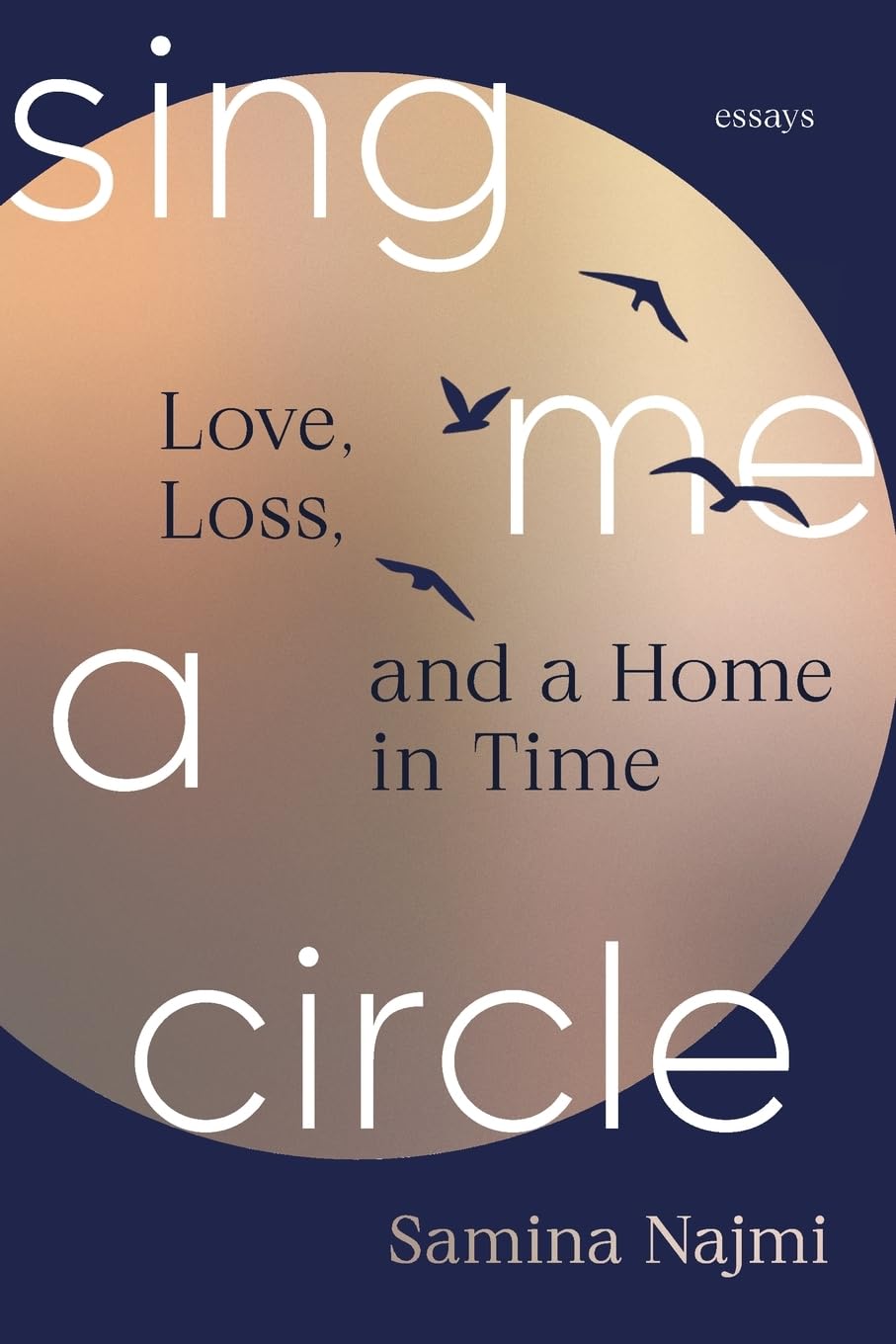
Review by Cameron Walker
As I read Samina Najmi’s moving essay collection, Sing Me a Circle: Love, Loss, and a Home in Time, I was reminded of a game we played as children in our school library. We’d gather around the globe and set it spinning. Then, one by one, we’d set out fingers down and imagine the lives we’d make wherever the globe had stopped.
The globe spins and stops and spins again throughout this collection: here on the grandparents in India; there on Najmi’s childhood in Karachi; now London, then back again to Pakistan. These essays follow her adult migrations, which take her from Boston to California’s Central Valley, where she’s now a professor of literature at Fresno State University. Many of these journeys also travel inward: into her relationships with her parents and her children, across the experience of culture, and into a mother’s body as it moves through space and time.
Along with traversing inner and outer worlds, Najmi’s words bring these worlds together, connecting the coordinates of changes and losses that make up a life. “I think when we live inside one home,” she writes, “we are also living in all the other homes we have ever inhabited. We live among those smells, those surfaces, those different dawns; we breathe the air of those homes populated by faces we will never see again.”
Folded between Najmi’s essays are italicized fragments that follow her cousin Rubina, the first woman in the family to win a scholarship to an American university. Three months before she was to leave Pakistan for Smith College, Rubina died by suicide. These fragments form a haunting descant to the collection, echoing the effect of Rubina’s absence on the family as a whole: from Rubina’s mother, whose grief appears in her own poetry, to Najmi’s own daughter, who plans to study clinical psychology, “prompted in part by this particular legacy of loss.”
I’m twenty-two today, I’m happy and in love. We gather around Irum, who reads our palms and tells our futures. You’ve been waiting for your turn, too. But at the last second, you pull your palm away.
Did you see the lifeline snapping eleven days later?
These sections allow Najmi to circle around the loss of Rubina, asking the questions that have no answers, at least not ones that will satisfy grief.
Late in the collection, Najmi wonders how the family survived her cousin’s death. “Did we survive it?” she writes. She could be asking not just about Rubina’s death, but about her own life and the lives of her family. She could be asking this from the bomb shelter in Karachi where she huddled as an eight-year-old, from or from her home in Fresno as her marriage ends. She could be asking — any of us could — about how we survive motherhood, the scattering of family, the journey of age. About whether we will survive.
I imagine for Najmi, who comes from a family of poets, essayists, and memoir writers, that writing itself is one of the life preservers that is part of her survival. It’s a buoy that she extends to the reader, as she illuminates the moments of connection and courage that family and place provide. As she prepares to say goodbye to her mother after an extended visit, she contemplates how she is changed by the parting.
Already a memory—our two months together, living as though I never left Karachi, you never grew older, space and time just tricks of our idle imagination. You leave, as you have left so many times before, but this time you leave me a template for my tomorrows, of grace and tenderness, whatever the pain—
This template is not only received, but given — to her own children, and to those who travel alongside Najmi through this collection. As Najmi considers her daughter’s impending departure for college, she writes, “When Maya was little, her life and mine formed concentric circles, having different radiuses but the same center—a bodily reality while I carried her in my womb. But what mother would want to contain her daughter’s life within her own, even if she could?”
With all that Najmi reveals throughout the book, wanting to hold her daughter close seems reasonable. But in asking this question, Najmi has answered one of her own. She is a survivor, one who can send her daughter off around the spinning world, one who still has the courage to hold her own hand over the globe and set a finger down, imagining the future ahead.
Sing Me a Circle by Samina Najmi
Trio House Press October 2025
Paper, 336 pages.
ISBN-978-1949487480
Cameron Walker is the author of three books, most recently the short story collection How to Capture Carbon (What Books Press). Her essay collection, Points of Light, was a 2024 INDIES Award finalist. Her work appears in publications including The New York Times, Orion, Terrain.org, Blood Tree Literature, and The Panafold.