
 Review by Emily Webber
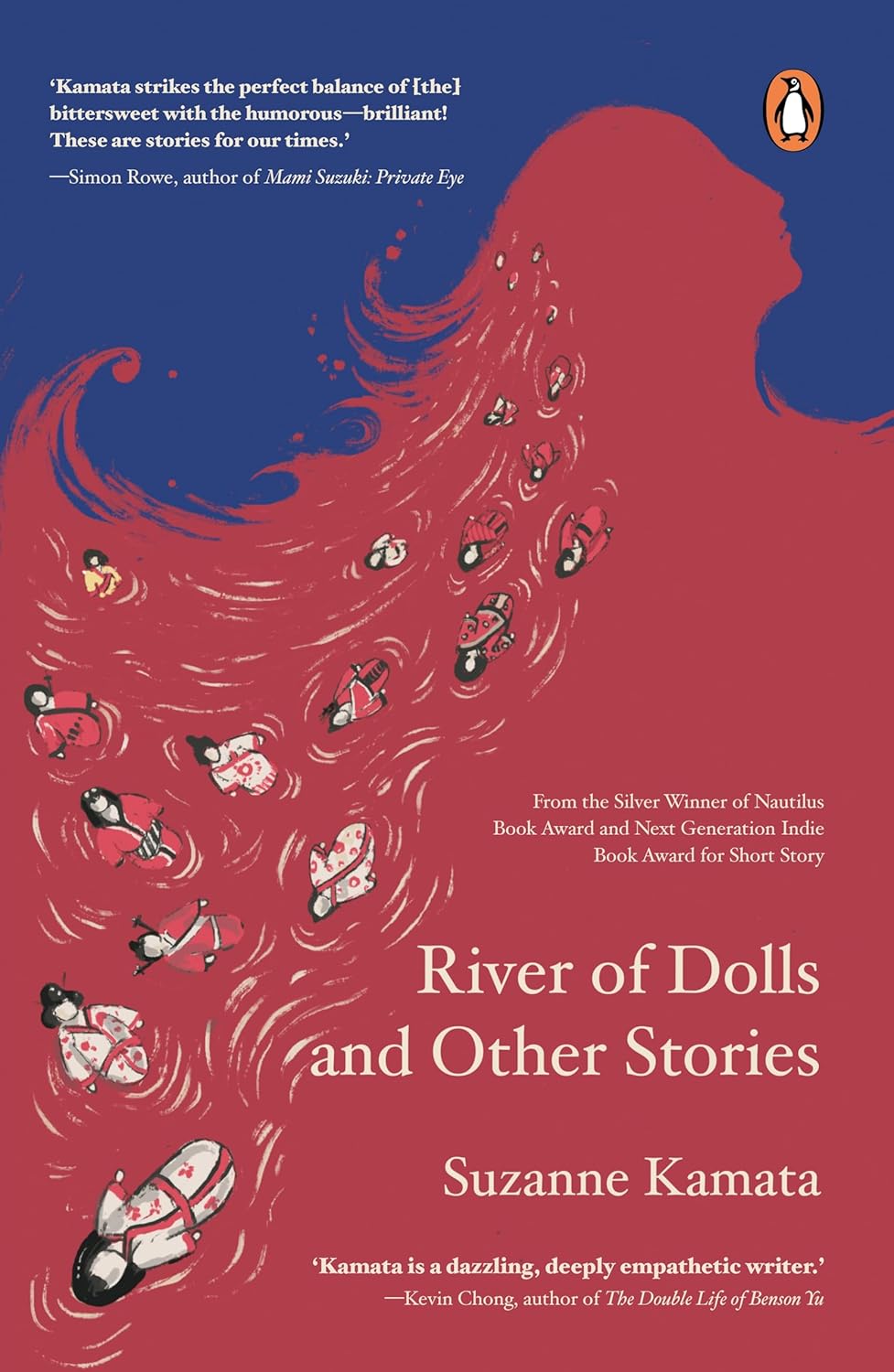
The characters in Suzanne Kamata’s short stories in River of Dolls are often caught between cultures, wishing for things they don’t have, and in transit to their next job, relationship, or new home. Big things happen quietly as they navigate everything from small disappointments to major life changes. Good intentions often don’t produce the desired results. Kamata, the author of another short story collection and several novels and nonfiction books, has spent half her life in Japan. Most of the stories in River of Dolls are set there, focusing on women and girls, where ordinary life intersects with different traditions.
But the collection opens with “Day Pass,” a story set in South Carolina that follows a young waitress who befriends a co-worker employed through a work-release program from a correctional facility. The interactions between the two gradually turn tense when she takes the woman out for a day. It is a good introduction to the stories that follow, illustrating the complexity of relationships and differences in life experiences.
“Blue Murder,” at the beginning of the collection, ranks among my favorite reads. It’s the kind of story that opens something inside you that you’ve always felt at the edges of your being but didn’t want to admit or name. Reading it forces you to face an absolute truth about yourself: that you sometimes place the biggest, most unrealistic expectations on those closest to you. That it is easy to look outside in moments of sadness or loneliness and imagine that something different would be better.
It’s one of the few stories told from a male perspective, and it begins with Keita, the main character, falling in love with a bird. He owns a pear orchard, and his days are long and filled with hard work. He does everything he can for his family and their legacy. Recently, he’s been upset that his son hasn’t learned the word “papa,” despite calling out to his mother and the cat, and that his wife has been caught up in caring for their baby. He feels insignificant and underappreciated by those who should care about him the most. A Kingfisher suddenly appears in the orchard, and Keita becomes obsessed, dazzled by its beauty and movements, seeing it as a sign sent to him as a consolation for his pain.
He imagined being lifted by those great white wings, being carried away from the river, skimming over the tops of the pear trees in his orchard, and then continuing across the Pearl Bridge and beyond. He would leave all this behind and travel to another country. Maybe once he was gone his wife and son would finally appreciate him. Perhaps they would think he had joined the ancestors and pray to his photo, setting out his favourite foods every morning at the altar. Meanwhile, in some other land, he would find respect and love. There would be no more crows, no more Kitty. He would begin again.
“Blue Murder” captures the epic loneliness of life at times, even when we have people who love us, and we love them in return. It’s a perfectly crafted story—just enough. A thread unraveling from its pages to the reader, asking: Have you also felt this?
Some of these characters find motherhood in unconventional ways. In “River of Dolls,” the woman discovers her husband is infertile but becomes pregnant after a one-time tryst. She hopes to pass the pregnancy off as a miracle to her husband. An American woman in Japan in “The Incan Ice Maiden” thinks about her ex-boyfriend, who left her because she wanted a child, and becomes pregnant from a fling. Both are fleeting encounters that will give these women what they have long dreamed of, but in unexpected ways, with uncertain futures.
Other mothers focus their attention elsewhere or encourage their daughters to seek out more. In “Snow Woman,” a mother dies climbing Mount Everest, leaving her daughter question her priorities. Another mother tells her daughter the tragic story of her sister and urges her to escape their history and traditional expectations to find a life elsewhere.
Whether or not they are mothers, in River of Dolls Kamata gives her characters both unexpected joys and challenges, layered with ancient history. Some characters sink into disappointments, while others rise from them in unforeseen ways. Most of the stories in River of Dolls successfully explore the idea that people often yearn for what they do not have and the surprising ways they find to fill that absence.
River of Dolls by Suzanne Kamata
Penguin Books, January 2025
9789815204964
Emily Webber is a reader of all the things hiding out in South Florida with her husband and son. A writer of criticism, fiction, and nonfiction, her work has appeared in The Rumpus, the Ploughshares Blog, The Writer, Five Points, Necessary Fiction, and elsewhere. She’s the author of a chapbook of flash fiction, Macerated. Read more at emilyannwebber.com.