
 Review by Katy E. Ellis
Joanna Streetly is a prize-winning Canadian poet and non-fiction writer who emigrated from Trinidad and has lived on the unceded territory of the Tla-o-qui-aht on Vancouver Island for the past thirty years. The poems in All of Us Hidden sweep the reader into Streetly’s past as a young stepmother new to Canada and whose two stepsons disappear (presumably drowned) when they are adults. Streetly’s collection grapples with this loss as well as the loss of her mother, the birth of her own daughter, and the dire relationship humans have with Mother Earth. Every poem builds on the gentle, gnawing sense that interconnectedness is an observable and actionable truth. The language is both plain and complex, at times humorous and always emotionally honest.
In the section “Dear Island”, the poet looks back from a literal island of memory where she experienced life as an outsider, slowly embracing a new nature within and outside herself. While she adapts to her new environment, she recognizes her awkward contentedness as noted in the poem “Thrown”:
boys do not care for questions about where the best stones come from or if they mind being thrown… novice stepmother, not part of this quick world… my life is like a stone, the way it seems to have arrived in their hands; how it wishes to stay (22).
This book takes a surprising but necessary detour as we learn the poet’s younger self—like so many young women—experienced trauma to her own body and psyche. We see All of Us Hidden as a wider reaching address of pervasive sexual abuse in our society that the #MeToo movement shed light on. There is hopefulness when the poet aims to reclaim her body and humorously states, while skinny dipping solo, “it’s my breasts I fret about/the luminous display of them/their habit of pointing things out” in the poem Swimming in My Skin (48).
All of Us Hidden emits a deep love and protectiveness of nature. Throughout the book, Streetly gives voice to the environmental crisis. There is no preaching or heavy-handed shame. Instead, there is questioning and observation. Of basking shark, she asks
“Will we ever stop expecting to see them?
(these waters now unfinned for years)
…memories our daughter
can never inherit, truths that grow ever thinner
vanish like ice moving south (74)
And in “Civil Disobedients” she wrestles with her fear of protesting—an activity she participates in with her grown daughter—and asks herself “Is it enough that we all believe in trees? That this logging of the ancients has broken us?” and feels immense relief when her daughter returns to her “unlost, unhurt, unscarred, unscared” (77).
The structure of this collection is such that all the poems revolve around the book’s central section (and theme) “Living My Mother”—where much magic and transformation happens. We return to the poet’s childhood on a different island where she wistfully recalls her mother tweezing lice from the “unmown grass of my hair” (52). In the prose poem “Living My Mother”, each of the five stanzas begins with “My mother is dead.” As if the poet is convincing herself of this fact. However, like a fallen tree becomes a nurse log, this refrain transforms:
even though she is dead, she is rooted so deep in the meat of me, so coiled in my busy dark viscera, I am living her residue, her imperfect being scored into my bones, growing inward, inward (p. 65).
Here, we get the true sense that living and dying, mother and mothering, human beings and non-human beings blur together in the continuum of our existence. In “On Becoming a Mother” one of the most captivating poems in the heart of this collection the poet plays with the idea of conception, destiny, and the feeling of timelessness between mother and child.
I wondered
if I’d found you
in the garden
put you in my pocket
for later, […]
…that feathered past
into present
grew our flesh together
& apart)
How many lifetimes
since our first encounter?
…I ask the geese
wise with skysight
but their cries do not tell
who I was back then
when you found me
In this poem, what is hidden is found. And the reader wonders if the you in the poem is the poet’s mother or the poet’s daughter or the Earth itself. In All of Us Hidden, Streetly looks at grief and trauma and leans into her mature bond with nature to reveal an ever-expanding embrace of death and life.
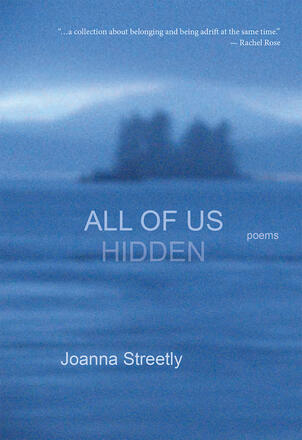
All of Us Hidden by Joanna Streetly
Caitlin Press, 2025, $20.00, 96 pages, paperback
ISBN 9781773861722
Katy E. Ellis is the author of three full-length poetry collections: Nature vs. Girl (forthcoming, Fernwood Press), Forty Bouts in the Wilderness (MoonPath Press), first runner-up for the 2024 Sally Albiso Poetry Award, and Home Water, Home Land (Tolsun Books), a novel-length prose poem. Visit www.KatyEEllis.com.