
 Review by Lisa C. Taylor
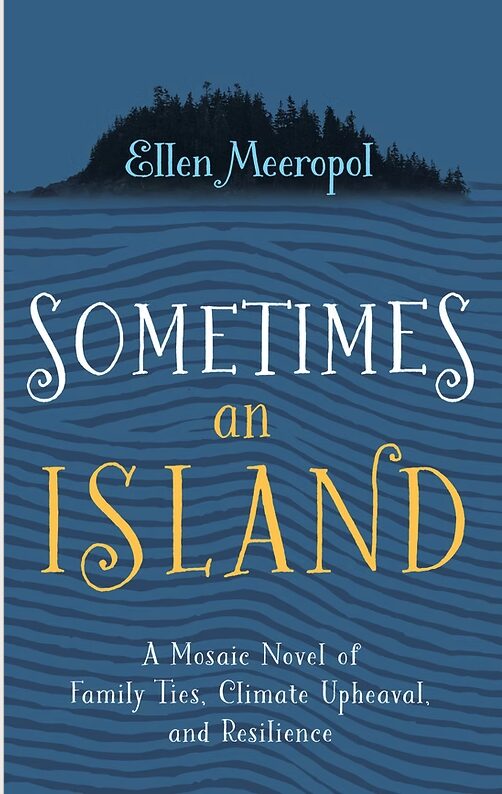
Sometimes an Island is a short but mighty novel-in-stories that opens with a prologue and brief history of pogroms against Jews in the Russian empire in the early 1900s. The escape of three young men and a girl who settle on an island in Penobscot Bay, Maine frames the story. These early refugees will impact future generations who become climate refugees after global warming leads to an extreme weather event called The Undoing in 2029. Part cli-sci, part literary fiction, part parable, these connected stories warn as they weave the reader and in and out of time periods with an unusual sort of cohesion. There is an illustrated family tree in the beginning, and it is helpful in sorting out the many interconnected relationships and time periods throughout the book.
The story is told by different narrators, beginning with Sadie, the grandmother. With her husband, David, she created an off-the-grid community inland in Maine, bringing little with her except the nesting matryoshka dolls that her great-grandmother rescued when she fled the Cossacks. She invites her mother, Esther after her father dies but her mother refuses to leave the island though Sadie knows it won’t be safe from flooding in the future. Her son and daughter-in-law, Marc and Evelyn, and their kids agree to join them though the kids, particularly a fifteen-year-old daughter, Tille, is unhappy to be given no choice about leaving Brooklyn. There is no internet in the remote enclave which is unacceptable to teenage Tillie.
The first story begins in 2022 after a Greenland glacial melt, a warning that everyone living on islands and in coastal areas would face the danger of rising seas. Migration to escape the consequences of climate change is a real and vexing problem in the 21st century. Sadie contemplates what she has done in inviting her son and family to uproot themselves from their Brooklyn home where they had friends and jobs., “Scientists say we carry trauma in our DNA and I believe that’s true. My cells carry all the catastrophes of my people, going back forever. So, Marc must inherit that genetic scar tissue too.” (15) The young child, Rose, who suffers from asthma, blames herself for the move because she was hospitalized because of the smoke from wildfires. This book spans generations and Meeropol’s style of moving in and out of time periods is effective in tying together the generations. The intergenerational alliances make day-to-day life in the compromised environment worth living. Ellen Meeropol reprises characters from her other novels, and that has the effect of making the reader feel part of a larger ecosystem that seems both viable and cautionary.
The story is not linear and is told by different characters spanning multiple generations and time periods. The community, later referred to as The Homestead is primarily self-sufficient. The only internet initially available is at the town library which is not close by. A major electrical grid blackout becomes a test of their self-sufficiency as well as their empathy as outsiders suddenly request shelter in their converted building. At The Homestead, they are forced to think about the limitations of their lifestyle and activism, but they are also compelled to consider the needs of the entire community which spans in age from infant to elders. “I am afraid for the future. I look down at my mug, and my finger traces the painted outline of a purple crane. Its wings are opened wide, and I let my heart crack open.” (53)
Not surprisingly, relationships are what propels this powerhouse of a book. As the community faces multiple hardships, even the youngest members have something to contribute. They are recognized, heard, and valued and that, in itself, is a lesson for our modern world. The alliances between the young and the old are a prescription for these fragmented times. It is clear that there are no easy solutions in The Homestead but there are moments of lightness, communal meals, and the idea that everyone matters.
Sometimes an Island is a tour-de-force. All of our hearts may crack open with its cautionary message. It heralds community as an essential part of the path forward and that is a positive message. Speak out and fight to preserve our environment but don’t forget your neighbors and friends, allies on this often-perilous journey. It’s hard to argue with that.
Ellen Meeropol is the author of five other novels, and the play Gridlock. She is a guest editor for the anthology, Dreams for a Broken World and her essay and story publications include Ms. Magazine, Lilith, The Boston Globe, Guernica and others. Her work focuses on the lives of women, especially those on the faulty lines between political activism and family. She’s been a finalist for the Sarton Women’s Prize, longlisted for the Massachusetts Book Award, and selected by the Women’s National Book Association as a Great Group Reads. She is a founding member of Straw Dogs Writers Guild.
Sometimes an Island by Ellen Meeropol
Sea Crow Press, 2026
9781961864504
$19.95
Lisa C. Taylor’s most recent publication is the novel, The Shape of What Remains (2025). Her other publications include two collections of short fiction and three poetry collections. Lisa C. Taylor’s honors include Pushcart nominations in fiction and poetry and the Hugo House New Works Fiction Award as well as the Gerson Honor along with Irish author, Geraldine Mills. Lisa’s second novel, Like Gravity, Like Love will be published in the spring of 2027.