
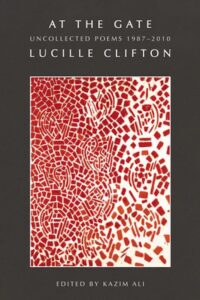
 Reflections on At the Gate: Uncollected Poems 1987-2010 by Lucille Clifton
by Mariahadessa Ekere Tallie
Lucille Clifton always reminds me of things I need to remember. I’ve written often about how when I was a new mother a photo of Clifton reminded me to discard any remnants of the nonsense I might have internalized about choosing art or motherhood. I still remember, clear as a sunny summer day in Jamaica, Queens, seeing a black and white photo of Clifton surrounded by her six children. I tucked the photo away like a talisman that would guide me—then a mother of a 5 year old and a 3 year old—back to poetry.
When I think of Lucille Clifton’s poems I think of daring, life-affirming decrees. Her poems are prayers, odes to self-making, odes to surviving and thriving with spiritual panache. I have talked with friends about the powerful ways Clifton’s work reminds us that we can create and recreate ourselves.
born in babylon
both nonwhite and woman
what did i see to be except myself?
i made it up
here on this bridge between
starshine and clay,
(“won’t you celebrate with me”)
My friends and I marvel over the ways her writing walks us through devastation but somehow never leaves us feeling defeated. Consider “Miss Rosie:”
when i watch you
wrapped up like garbage
sitting, surrounded by the smell
of too old potato peels
* * *
i say
when i watch you
you wet brown bag of a woman
who used to be the best looking gal in georgia
used to be called the Georgia Rose
i stand up
through your destruction
i stand up
Clifton watches, she refuses to turn away, and she stands up, which is to say she salutes Miss Rosie’s humanity, her story, even in the face of destruction. Clifton stands up, her pen paying tribute and directing us to not look away. There is a dignity restored to Miss Rosie through Clifton’s seeing and standing.
And so maybe I was unprepared for At The Gate. These are Clifton’s uncollected poems which Kazim Ali has carefully gathered and written beautiful notes about. He writes “Some of these poems might not even sound like “Lucille Clifton Poems” in the way a reader might expect.” I agree. These poems are “edgier” as Ali writes. Clifton is not turning away from destruction in any of them; she is as courageous as ever but the glimmers of hope I am used to finding in Clifton’s poems are often not there.
These poems describe ghosts—hauntings by history, unfulfilled ancestors, racism, pollution, and current events. In “postcards” she writes about “How tomorrow left with the children.” In “the baby” she writes from the point of view of a mother admiring her newborn, drawing readers into community with the mother, only to get to the last line where we discover that the narrator is Hitler’s mother. In “haiku for hokies” Clifton writes of the need for compassion for the mothers of college students killed in a mass shooting and the need for compassion for the shooter’s mother as well. In “Television News” where children suffer because they know terrible truths that might await them in the future:
Our children
are looking out
murdered children
eyes drowning in
each others’ tears
some of them
will die from this
and they know it
some of them
will live with it
and they know that
too
Kazim Ali’s foreword and his notes provide wonderful, rich guides for the reader. Some of the poems are drafts and the finished poems have appeared in other books, some contain the seeds for other poems; through his notes Ali alerts readers which poems that fall under these categories. Sometimes, we see more than one version of a poem, side by side. He also fills in details that will help even those familiar with Clifton’s work orient themselves in the poems.
Grief, shadows, loss, regret and wars fill most of these pages. In these poems Clifton does not often share the wisdom she has gleaned from difficulty. She simply states the hardship, which is not at all simple to do. If At The Gate was someone’s introduction to Clifton they wouldn’t know the Clifton her loyal readers know. At The Gate is an exciting collection because it lets us see Clifton in process and it allows us to see the ways that she insisted on bearing witness while admitting that it is at times “terrifying” to see. (untitled, 49)
There is agony in At The Gate and still, miraculously, there are whispers of “Glory, Glory, Glory.” (“black girl looking at a blackbird”). There is still the claiming of space, the creation of self–here is the cherishing of a breaking, limping, self who does despair but ultimately will not be defined by despair. There is still an insistence on living and there is an inability to turn away from love.
The toll of seeing is on full display in At The Gate. Yet Clifton’s urges (“in the mummers play”) a Black woman who makes art to “wear your own face” and
Remember
in the house of art there is a dark
and ancient door sing it down
enter that room belongs to you
Through At The Gate a seemingly different aspect of Lucille Clifton tells us to get to work. Surrounded by the destruction of the current administration we must write what we see even if we can’t summon a thread of hope to weave through the moment.
it is about questions
not answers
it is about truth
Not fact, not opinion
It is about courage
Not safety.
(untitled, 102)
Thank you Lucille Clifton for this light.
Your light.
Again.
At the Gate: Uncollected Poems 1987-2010 by Lucille Clifton
Edited by Kazim Ali
Boa Editions, April, 2026
Paperback | ISBN: 978-1-960145-98-7 | Price: $21.00
Mariahadessa Ekere Tallie, PhD is an interdisciplinary artist, poet, performer, educator and scholar. She is the author of the poetry collections Strut, Karma’s Footsteps, and the epistolary work Dear Continuum: Letters to a Poet Crafting Liberation. She was awarded the 2026 Golden Kite Award for picture book text for her second picture book We Go Slow which was also named a Junior Library Guild Gold Standard Selection and a NYPL best book of 2025. Her first picture book Layla’s Happiness won an Ezra Jack Keats Honor. Dr. Tallie is the mother of three galaxies who look like daughters. www.ekeretallie.com