
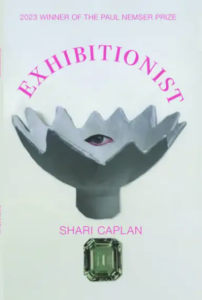
 Unvarnished Animal: A Review of Shari Caplan’s Exhibitionist
by Hannah Larrabee
In her prize-winning collection, Shari Caplan opens with a poem invoking the incomparable Marina Abramović:
Here is the gallery of my body.
(…)
You’re not supposed to chew
the pomegranate seed. This is how
I imagine our relationship:
You, reader, the mouth
opening to all my red beads … (1)
You might be familiar with Abramović’s living exhibit at the MoMA—how she couldn’t help but break her stoic gaze when she looked up and saw her former partner, Ulay. Desire is at the heart of Exhibitionist, its clarity and its confusion. We are, all of us, “unvarnished animal (3)” in whatever role we take, be it mother, husband, lover, or all of these at once … “the artist asks us / how many versions of ourselves do we marry (55)?”
The poems in Exhibitionist deftly examine the relationship between the observer and the observed, alongside the infinite languages of our bodies. Let’s not forget this is a fundamental question of the universe. Whether the dramas of interaction and attraction play out daily on a sidewalk between strangers, or between lovers new or established, even at a quantum level far outside our reach: observation changes things. And in a sweeping allegory, observation creates the universe—creates, essentially, relationships.
Shari Caplan might not consider herself a cosmologist, but here she is at work studying the intricacies of orbits in so many of these poems:
My vision, your vision collide (5) …
We hunt out places
where shade overlaps with my delight (66) …
I can’t assemble myself
until you enter (22) …
I talk interiors until I leave untouched (12) …
There is a subtle current running through Caplan’s poems that pulls me back often to this collection. Yes, attraction is at work here. But it’s attraction with discernment, attraction that demands attention to the inherent and learned rhythms we acquire in relationships. Frankly, a painting, or even a handwritten letter, can be a better date than another human being and no less erotic.
I do feel there is a sadness in these poems that has to do with a vibrance that is sometimes asked to dim itself. Sometimes we must guard the boundaries of relationships. Not everyone is meant to be a minor sun; some of us radiate in ways that cultivate an interlacing of energies. And so often that requires preservation. “I will not apologize for wearing wings in place of my back. / Simply envision a great leap and disappear (77).”
Caplan’s poems navigate this delicate, sometimes abrasive, territory. This is the work of energy: where to put it, how to care for it, how to offer it—truly offer it—to another.
These poems sit at the altar of energy: erotic, creative, intuitive, contemplative. They invoke Audre Lorde’s The Erotic as Power: “the erotic is not a question only of what we do; it is a question of how acutely and fully we can feel in the doing.” Caplan’s work moves with the fluidity of desire and always comes back to the foundation of self, a self-radiating power. From such a place, what we find attractive and who we find attractive can change. In not settling for what is expected, a fierce and authentic desire thrives that requires both witness and privacy. The dance. The gaze—both masculine and feminine. The many roles we inhabit.
Caplan ushers us expertly through the gallery of “unvarnished” desire, one that requires you stay behind the line and look closely until, perhaps, there is a mutual invitation. Anything less would not be connection, would not come close to the energy and vibrance these poems possess—and require in return.
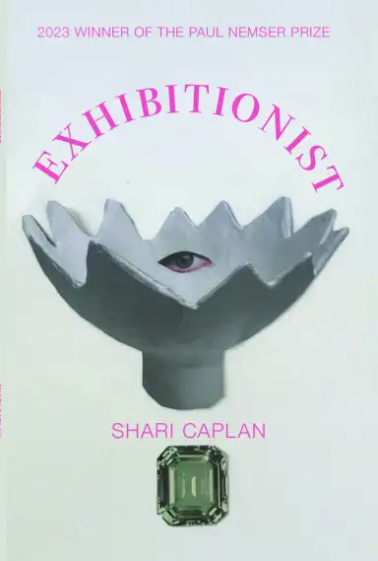
Exhibitionist by Shari Caplan
Lily Poetry Review Books, 2024, 102 pages, $18
ISBN: 978-1-957755-36-6
Hannah Larrabee‘s Wonder Tissue won the Airlie Press Poetry Prize and her chapbook—The Observable Universe—was longlisted for a Massachusetts Book Award. Language Erratics, her newest Arctic Circle collaboration with artist Jacinda Russell, will be on view at The Poetry Center in Tucson in 2026. hannahlarrabee.com