
Review by Elizabeth Paul
Susan Ayres is a poet, translator, and lawyer who teaches at Texas A&M University School of Law. She is the author of Walk Like the Bird Flies, a chapbook that journeys through inner and outer landscapes.
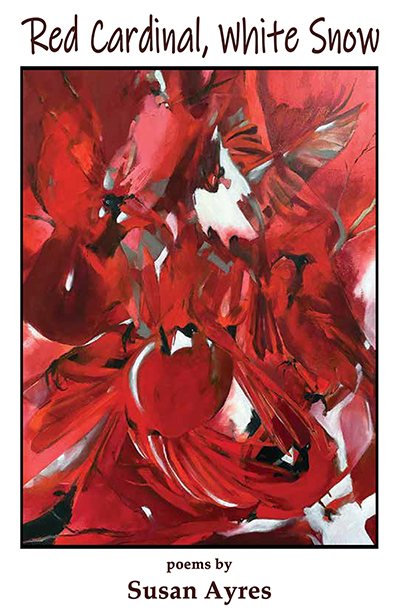
Ayres’ second chapbook, Red Cardinal, White Snow, explores intergenerational mental illness and family trauma. Dedicated to her mother and daughter, this collection provides glimpses into the lives of these women, both of whom lived with mental illness. It also brings readers into the narrator’s experience as a daughter and mother seemingly tethered to tragedy. Yet the links between mothers and daughters ripple a chain of light through poems that transcend labels of trauma and psychosis in their complex and tender rendering of linked lives.
For readers who have never lived with mental illness, this book provides an idea of what it can be like. Meanwhile, anyone who has dealt with psychosis and trauma—or weathered other severe hardships—will find solace in Ayres’ faithful and illuminating witnessing of suffering and strength.
Ayres introduces her mother in “First Psychosis, Then the Aneurysms,” a poem that intertwines episodes of her mother’s mental illness with her own recollections. It begins:
My dead mother spoke to me
in a waking dream. She
said, You are fat—
without judgment, without
affect, like Let’s have an
egg for breakfast,
which she would often say
as she figured out the crossword puzzle. (11)
The narrator then recounts a time her mother revealed she once considered killing herself and her girls, adding
I pretended not to be stunned,
nodding while she explained
her then-psychosis . . .
. . . startling me
with how lucky I was to be alive. (11-12)
Ayres deftly depicts the narrator, her mother, and their linked experiences. Through the narrator’s waking dream, she links past and present, bringing home the liminality of the mind in this poem about mental illness. Also remarkable is how this poem pays tribute to the mother’s unique identity even while it tells the story of a psychosis that would obscure the same.
While the mother is rendered in humanizing details such as breakfast eggs and crossword puzzles, the daughter is depicted as a force, as in “Mother’s Day”:
Our daughter
is like a tornado
Unpredictably
stirred up from springtime
lightning storms, pressure systems.
All we can do is batten down. (18)
Through simile, alliteration, and lyricism, Ayres brings home the daughter’s dynamism. This unpredictable power is also present in “Reconciliation: Retrograde,” which begins:
She’s fiery eccentric, incandescent, erratic
I love her fiercely no telling how the
planets rule
her sway (35)
Here lineation and spacing draw a parallel between the fiery nature of the daughter and the narrator’s fierce love. It’s as though they are linked, and the power of the daughter’s nature is matched by the mother’s love—a force in its own right, embracing a daughter who is awesome as a tornado.
In “Storm,” the narrator’s mother-love is not seen in fierceness so much as simple endurance. In this poem, the daughter has told her boyfriend that she’s afraid her parents will hurt her—an unjustified claim the boyfriend’s mother believes, warning the narrator to stay away or she’ll “call the cops.” The narrator continues:
I stand in the street and helplessly
watch the spring sky, a gray
ocean of clouds. Rain
but no rainbow, no
silver lining, no augury
telling me how to raise a girl
who skips school, breaks family rules, grabs the steering wheel
and sneers I could kill us both, you know. She threatens
to jump off the roof onto the driveway below, begins
cutting, self-piercing. (17)
…
While the details of the daughter’s behavior bring home what it’s like to raise this young woman, Ayres’ syntax, layout, and imagery pound home the heaviness and helplessness of weathering such a storm. In this poem, it is not the daughter so much as a mental health crisis that lowers over the narrator and her family, and an image of a dead bat flattened by the storm seems to both represent the narrator and gesture toward others who suffer such storms.
In the end, it is Ayres’ big-heartedness that makes this chapbook not only a rendering of mental illness or depiction of mothers and daughters, but a book about courage and love in the face of hardship.
Red Cardinal, White Snow by Susan Ayres
Main Street Rag Publishing Company, 2024, $13.00 paper
ISBN: 9781964277158
Elizabeth Paul’s poems, essays, collages, and collaborations have appeared in such places as Cold Mountain Review, The Carolina Quarterly, and Duende. Her chapbooks Reading Girl and Blue Lovers are ekphrastic explorations of the art of Henri Matisse and Marc Chagall. She teaches at George Mason University and her website is elizabethsgpaul.com