
 Review by Sharon Tracey
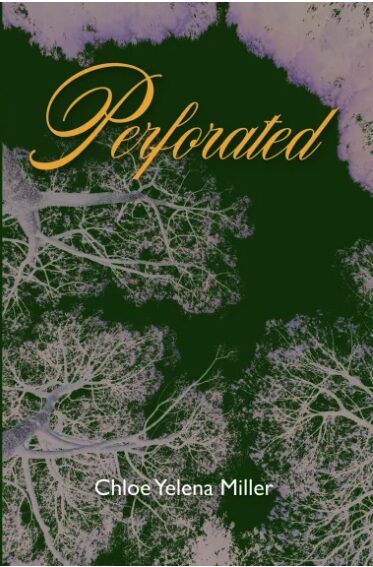
In Perforated, Chloe Yelena Miller’s second full-length poetry collection, the poet circles the center of things, observing and remembering. In her hands, words are gathered around portals between the outside and inside as well inside the body of memory, with places for language to land and embed in. Hands that light candles, drop coins in a collection box, mix olive oil and salt; hands that rest under the hand of a child. Hands that fill a jar with anything that needs a container, to be held.
Inside these intimate poems, the poet celebrates the details of daily life both home and abroad, and the way place and language can anchor and transform us. There’s a great aunt, a roller coaster, water guns, and real guns; Etruscan bronzes, butterflies, and bombs. Lost friends and strangers and bridges to cross. There’s the unpredictability of nature, of landslides and tsunamis, and also of human nature.
Miller begins by setting us down in the Pantheon (p 1):
My child’s night shadow
on the Pantheon lengthens
into the passato remoto,
the distant past.
The past without our many lights
along the street, blinking from cars
and motorini over the bumps.
…
Divided in two sections, the poet stitches several recurring motifs throughout the collection, like a needle piercing cloth or a page of words. One is a series of six New York City poems (titled, “NYC 1” through “NYC 6”) as she walks the city streets, observing. Many poems include flashes of artworks along the way, including Georgia O’Keeffe nightscapes, Caravaggio, and Donatello’s David. She’s looking up at the city. She’s looking at edges, remembering. There’s past time in Italy, pandemic time, post pandemic, pre and post 9/11.
The act of stitching things together echoes in a later poem, “She sewed,” (43) as Miller writes:
two raincoat sleeves or
a zipper into a seam.
Each section produced
on a separate line.
I think of myself like that:
Pant legs divided from
my shirt hem
by the leather belt.
Two connected halves.
…
Vocabulary poems, each led by a specific Italian or English word, are also stitched throughout, holding words together—spelling and definitions, meaning and understanding. Italian words like Intimissimi, Vita, and Luna Sul Colosseo. In “Italian Vocabulary: Guardare” (p 8) the poet writes of the “things we can’t see or didn’t, like the moment the man leapt or fell from the footbridge over the Tiber River.” And later, how “We fill in what we can’t see to understand / and wonder what’s right.”
In “The Bed Lost Its Lives” (p 9) Miller shares the story of when her bedframe lost its screws and she reported it to maintenance, “replacing viti, screws, / with vite, lives: / the bed lost its lives.” Things can go wrong without the right words. But sometimes, there’s a chance for double meaning and surprise, a seed for a new idea or poem (and a satisfying poem title).
In “Containing,” (p 38) the poet considers the act of collection, reflecting on the things lost to time, landslides, tsunamis.
In boxes: Shells glued to felt, once framed. Labeled rocks.
…
In a nursing home. Can we ship nature? …
Once, in the night, a nearby house slid down the mountain, waking the people
inside.
…
Wherever I go, I watch people’s hands. The skin that thins, while containing.
What they hold.
There’s a “Valentine for Our Seven-Year-Old,” a “Letter to Another Mother,” and a final poem, “Coda,” addressed to the poet’s child. Through one lens the collection might be viewed as a valentine to not only her son, but to the world of children and parents, carrying the worries, loves, dangers, and difficulty of letting go in the face of school shooters, random violence, and the unknown.
In the penultimate poem “Palimpsest,” the poet writes (p 51):
If I were commissioned to design a church,
I’d design it for you, child.
I’d set the dome on high ground.
Nearby, impossibly tall marble door
disguised by filigree carving:
Ever rotating exhibit of light and dark.
Surface all texture and shadows. Stories
wouldn’t matter, just the shapes.
Or are shapes only disguised stories?
…
In Perforated, Miller has shaped a container each of us might hold. And perhaps consider what container we would choose to hold our own stories and memories.
Perforated by Chloe Yelena Miller
Lily Poetry Review Books/ Poetry 2026, $18.00 [paperback]
ISBN: 9781957755649
Sharon Tracey is the author of three books of poetry: Land Marks (Shanti Arts 2022), Chroma: Five Centuries of Women Artists (Shanti Arts 2020), and What I Remember Most is Everything (All Caps Publishing 2017). Her work has been published in Radar Poetry, Terrain, Lily Poetry Review, The Ekphrastic Review, and elsewhere. She previously served as a director of research communications and environmental initiatives at the University of Massachusetts Amherst.