
 Review by Melissa Kutsche
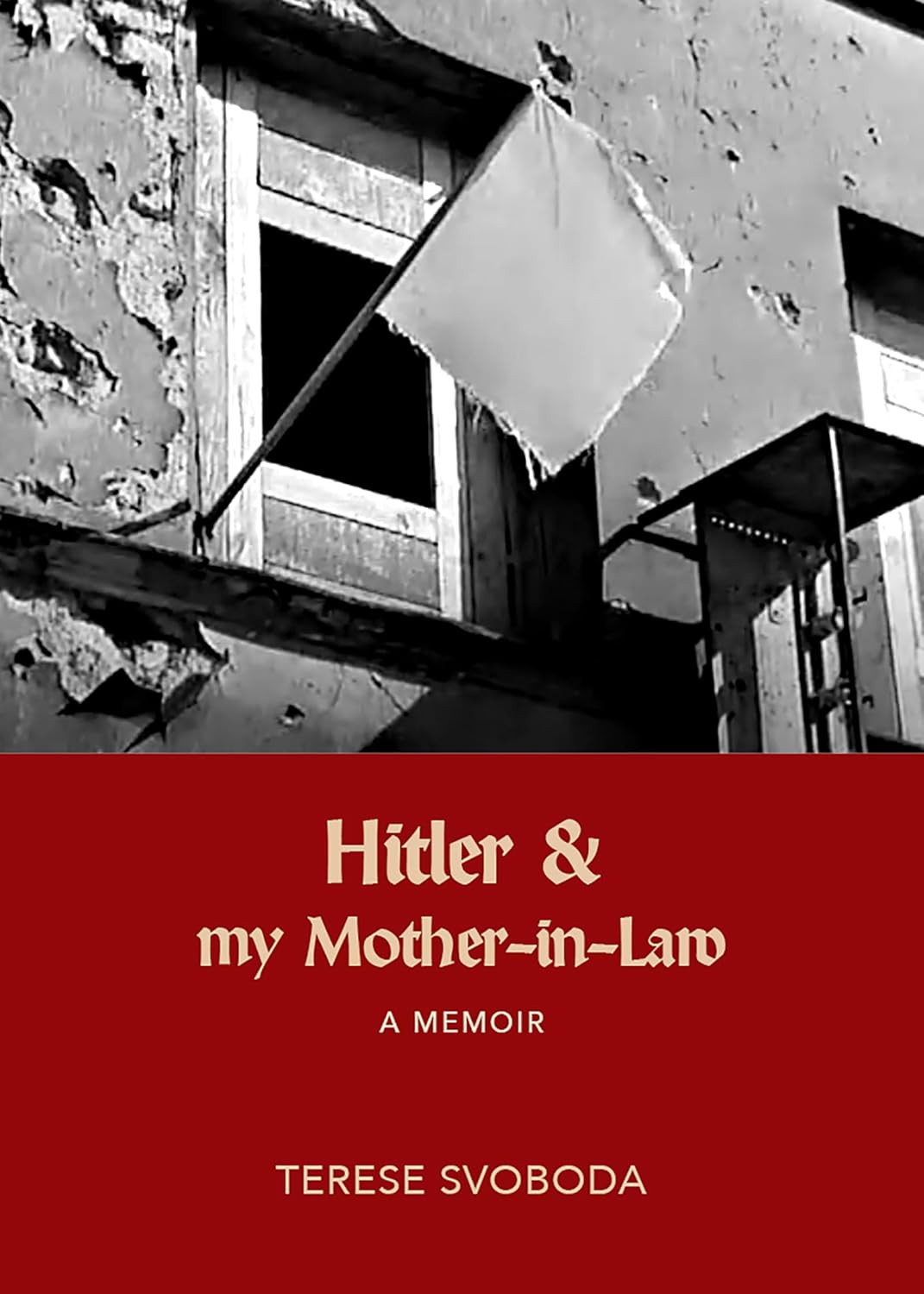
Hitler and My Mother-in-Law by Terese Svoboda focuses on the life and career of the author’s mother-in-law, Patricia (Pat) Lochridge Hartwell. Hartwell was the first woman hired in news at CBS Radio, worked for UNICEF, and was the first female journalist to report from both the Pacific and Atlantic theaters during WWII. In Hitler and My Mother-in-Law, Svoboda highlights how many of Hartwell’s stories have taken on a legendary quality after years of being told to family and friends. “Sometimes her sons say she lied or at least stretched the truth. She was Texan, what could you expect?” (13). But Svoboda, like Hartwell, is a professional writer, and she expects truth, not tall tales.
Svoboda is the author of 24 books and the recipient of many awards and accolades, including a Guggenheim fellowship, the O. Henry award, the Pushcart Prize, and the Iowa Prize for poetry. In her own words: “I am resurrecting Pat, who died in 1998 … to sort the peculiarities of what truth means today. The impetus behind all memoir is always about getting to the truth” (5). The search for the truth in Hartwell’s stories requires Svoboda to interrogate the memories of her late mother-in-law, and, as Svoboda warns her husband, “Look, my writing this memoir might entail rewriting your memories of Mom. Better stop me now” (12).
Svoboda dissects stories from Hartwell’s career and ruminates on artifacts that are as much a part of history as family lore, such as a now-undiscoverable photo of Hartwell gesturing to a pile of ashes rumored to be Hitler’s remains. Hartwell’s impressive resume and stories—calling Eleanor Roosevelt a friend; claiming to have danced with captured Nazi Hermann Goering after being present for his arrest; being appointed the mayor of Berchtesgaden, Germany in 1945; receiving an original Cranach painting that may have belonged to Hitler—are compelling enough to stand on their own, and I was curious about Svoboda’s decision to write a memoir rather than a biography of her mother-in-law.
Perhaps an effective biography could not have been written in the face of so much doubt, as there are many stories and memories that cannot be corroborated. And yet, the stories themselves hold important truths, even if the facts cannot be verified. Svoboda writes about this in another way when referring to artwork forgeries, asking, “Why should authenticity increase the value of an artwork? The aesthetic experience is the same” (263). Hartwell’s stories are valuable, whether or not they are completely verifiable.
Hitler and My Mother-in-Law reads like an extended braided essay, with vignettes from Hartwell’s life woven together with Svoboda’s own memories, notes on contemporary politics, and even mother-in-law jokes. By including her own experiences and writing a memoir rather than biography, Svoboda finds a way to quietly support her mother-in-law—beyond death, beyond time, and beyond doubts—by showing that she understands the role of truth in storytelling. Svoboda also knows firsthand that what is accepted as truth depends on factors such as censorship, propaganda, and the availability of evidence.
After sifting through her mother-in-law’s stories (and doubting their veracity in many cases), Svoboda concedes that disbelief due to a lack of evidence could be extended to some of her own experiences. For example, Svoboda writes of a time she crossed the Nile with equipment on her head, the water full of crocodiles: “No evidence of this iconic moment—you’ll have to take my word for it” (150). Implicit logic allows Svoboda to build a case for believing her mother-in-law: if the reader believes Svoboda, the reader should also consider believing Hartwell, even without someone else to back up her story.
Hitler and My Mother-in-Law might appeal to fans of the 2024 movie Lee, starring Kate Winslet, or readers of family memoirs such as From Here to the Great Unknown by Riley Keough and Lisa Marie Presley. For readers troubled by government officials sowing seeds of doubt by using terms like “fake news” and “alternative facts” rather than pursuing absolute truth, or the proliferation of artificial intelligence making it increasingly difficult to distinguish real photographs and videos from AI-generated content, Hitler and My Mother-in-Law provides a nuanced exploration of the truth: what it is, who we believe, and why?
Hitler and My Mother-in-Law by Terese Svoboda
OR Books, 2025, 416 pages, $23.00 paperback
ISBN: 9781682196519
Melissa Kutsche lives in Michigan. She writes about midlife, motherhood, books, and other sacred/ordinary things. Read more on her website and Substack