
 Review by Sharon Tracey
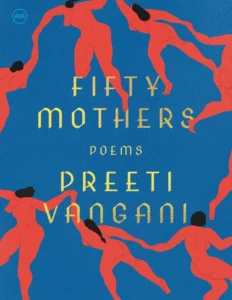
Both narrative and elegy, Preeti Vangani’s poetry collection Fifty Mothers explores grief and loss triggered by the death of her mother to breast cancer at age 41. With her passing, the poet and her father become “a ministry of less” (1) in a kitchen where take-out replaces home-cooking as the poet remembers and records.
Set adrift without the anchor of her mother, Vangani shows us that “mother” is too small a word for what becomes, over time, a matrix of women—including aunts, sisters, mothers-in-law, and cousins who offer a kind of spiritual guidance, appearing in the space where her mother once stood. From this liminal place, memories from her childhood in Bombay and the path to young adulthood shed their light in lyrical poems. There’s music in Vangani’s verses and a satisfying sibilance. In “Light Is a Moving Line” there’s the self who sees yet unsees, that “taps its foot to that bilabial sound of b.” There’s a moving line of light as “someone is guiding us to our places in this new dark.” (73)
What beautifully binds the collection together is the long prose poem, “Fifty Mothers,” which appears in five discrete parts (8, 16, 53, 66, 71), each subsequent vignette picking up a skein where the last left off, introducing more mothers along the way, including her mother’s four sisters as well as forty-five cousins, all of whom she calls maa-si, meaning like-mother. They come in many varieties—one losing her hair, one depressed, one who pours hot curses into ears, one dark as charcoal; two twin mothers who marry twin brothers, one who yearns for mystical naps. All have opinions, baggage, and possible cures as the poet listens and observes and writes them into being.
As the composite poem builds an eclectic group portrait, there’s an element of repetition that feels like an incantation that keeps the heart of the collection beating. Each mother brought to life by a vivid quirk or trait, set alongside the cultural tensions and expected norms of an Indian marriage, particularly among her mother’s generation. Set against this spine, many poems feel rooted in the poet’s body as she writes of desire, sex, trauma, and how intimacy can be numbed by grief as well as physical limitations, like her own arthritis. In “Lifestyle Disorder,” she wants to tell the rheumatologist, “nobody is coming. Not Mother. Not Motherhood.” (32)
There are list poems, filled to the brim with vivid images and sensory textures, as in “Catalogue of Intrusions on My Mother’s Breast(s)” (p 19): from a landline’s receiver to the black beads of her mangalsutra; lactation supplements to cholis and kurtas in lace and cotton; the benign lump and biopsy’s needle to mammogram clamps and doctors’ hands. In “My Gone Mother Sends Her Bucket List”(p 34) the poet draws up a list of things she imagines her mother would wish from the other side, among them: a paint job for gangrene walls, a microwave, a dignified shelf for gods, a chilled beer, a burning touch. Through these lists, Vangani brings her mother to life.
In “Blind Hem,” (41) midway through the collection, the poet writes:
…
I too tried repairing myself
by sewing grief into a pattern. But grief
isn’t as much a design as a seam.
It is what holds me in—
…
In “My Gone Mother Wants Me to Love Myself, Says” (49) the poet imagines what protection and practical advice her mother might pass along to her now, writing,
…I am
packing Multani mitti in your bag,
a walnut scrub, honey with cinnamon
and have you tried praying? God
is an easy customer. I wish you said
I love you to me as you did to the boys
in college.
… If you don’t finish
your beer, use it as hair conditioner.
If you can’t find alcohol, spit
on the wound. Marriage means
sacrifice.
…
In “My Gone Mother Sees Me In My Grief Overalls,” (68) the poet again gives her mother voice and agency with which to speak, writing:
…
Zipline on the rift of my unspent
anger. The unused skillet from my
trousseau shines for you, kiss
the initials engraved on its rim:
P.K.V. Could be me, could be you.
…
Make me a tiger. Grow taller
than monsoon grass. I’ll walk
through you and nobody will know.
Vangani shows us that, maybe, by allowing the deceased to “walk through us”—metaphorically and on the poetic page—a grief might more freely pass.
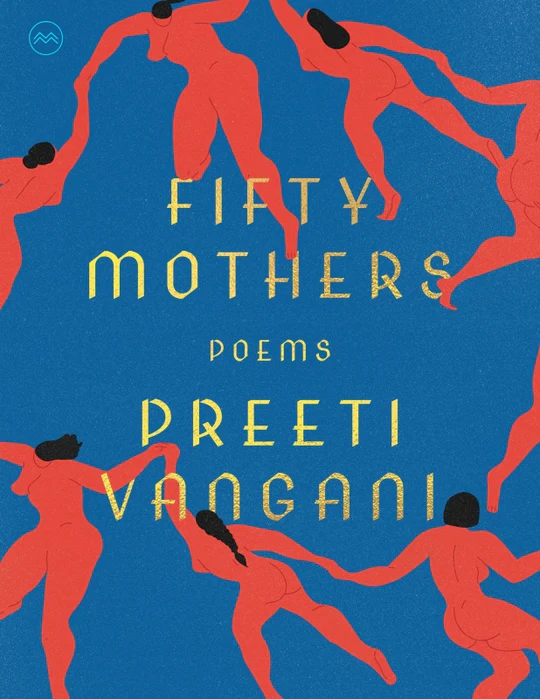
Fifty Mothers by Preeti Vangani
River River Books / 2026, $20.00 [paperback]
ISBN: 9798988137894
Sharon Tracey is the author of three collections of poetry: Land Marks (Shanti Arts 2022), Chroma: Five Centuries of Women Artists (Shanti Arts 2020), and What I Remember Most is Everything (All Caps Publishing 2017). Her work has been published in Calyx, Radar Poetry, Terrain, and The Ekphrastic Review, among other journals and anthologies. More at sharontracey.com