
A Conversation: Claire Millikin, author of Ghost Crab, with W.J. Herbert
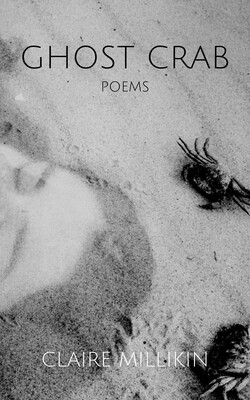 Ghost Crab: Poems at the confluence of water, memory, and survival.
In Ghost Crab, award-winning poet Claire Millikin invites readers into the living landscapes of coastlines, rivers, and tidal waters, where aquatic and semiaquatic crabs become powerful symbols of resilience, transformation, and survival. Rooted in the beauty and fragility of the natural world, these poems explore climate change, personal loss, memory, and the intricate connections between human and animal life.
Ghost Crab, forthcoming from Cape Cod-based Sea Crow Press in February of 2027, is Claire Millikin’s 12th poetry collection, the latest of her more than two dozen works. As the scholar Claire Raymond, she has published books as diverse as Photography and Resistance: Anticolonialist Photography of the Americas and The Posthumous Voice in Women’s Writing from Mary Shelley to Sylvia Plath. In the conversation that follows, Millikin not only talks about Ghost Crab in light of previous collections, but also of the ambivalence and ambiguity of writing about sexual abuse, and the how poetry connects to her scholarship and social advocacy work.
WJ: In your poems, light is often depicted as a physical manifestation of an emotional state, as well as an indication of the presence or absence of the sacred. In “The Golden Thread” from your 2021 collection, Dolls, a piercing light embodies the violence of shared grief between the speaker and her bereaved friend who has found little consolation in a Christian burial. In “Nightlight for the Confederate Dead” from your 2026 collection, Nightlight, it represents an even greater emotional violence and alienation from the sacred as, triggered by a confederate monument’s flame, a physically-abused child conjures:
…the open
place in the mind where you know
what you’ve been offered
as a guiding light
is worse than darkness.
But in Ghost Crab, your newest collection, the light in “When We Were Beautiful,” seems to offer emotional and spiritual refuge:
That broken year seen now
in photographs looks beautiful, as if nothing
did us lasting harm. In light’s last shallows
crabs with luminous tenfold eyes are surfacing.
Is the light in Ghost Crab indicative a more contemplative emotional state for its speaker and/or for you? Has your sense of the sacred become tied more closely to the natural world?
CM: That sonnet from Ghost Crab in simplest terms is about surviving the pandemic. My spouse and I lost our jobs; stress sickened me and I became significantly underweight; our adolescent child faced his own challenges. Our one respite was to drive to the woods outside Charlottesville and walk in the forested foothills. My spouse, Mark, took these photographs of us from that year in the woods, in retrospect looking so pretty – being emaciated makes your cheekbones stand out, and my son’s beautiful curly black hair grew long without access to barbers – that’s what the poem is about on the simplest level. It is also, as you note, that the beautiful Earth is still here, and even a time of suffering can attest to that beauty.
Light is a substance that I think about in my day-job as a researcher and teacher with a singular focus on photo-history. Light obsesses me. As a migraineur I sometimes see auras (less frequently these days, thankfully). Natural light is always delayed from its source, arriving light years after the combustions of the sun, the stars, that create this light. Light encloses us, a motherly substance. The French philosopher Roland Barthes calls it an umbilical cord, which I love and agree with. I’m hypersensitive to light, often wear sunglasses indoors in the morning to let my eyes adjust. Light is the most extraordinary aspect of our life on Earth –that we on this earth are bathed in light. I don’t think my sense of light has evolved in poems as rather it is mutable and always changing – light burns, the sun burns, and light consoles and mothers us. Light is sacred. The sacred can be both dangerous and protective. So, yes, you’re right, if there’s anything left that I believe in, it’s the ‘natural’ world where time and light persist in the places people haven’t coopted entirely just yet. The sky is there, remembering everything.
WJ: A number of poets have written about the sexual abuse they endured in childhood. In her poem, “Rage,” Mary Oliver writes to the father who in the night stumbled “… to the child’s bed, / to the damp rose of her body, leaving your bitter taste.” In her “letter from my brain to my heart” from Blud [Copper Canyon, 2017], Rachel McKibbens describes its effect: “There is no prayer / or pill for this. / It is a ruthless botany. / I might as well / be buried in the yard.” In your own poem “The Georgia Mud,” from Nightlight, an abused speaker excavates “…what lay buried, what mothers would never confess,” and in your newest collection, Ghost Crab, the speaker in “Semi-Terrestrial” confirms:
Drowning is my origin.
As a child, I appeared to live
above ground, but each night sank
back down into my father’s want.”
Though you write from a uniquely Southern perspective, what kinship, if any, do you feel with these, and other poets, addressing sexual abuse?
CM: I admire Mary Oliver on so many levels including admiring that she walked away from abuse and created one of the most gorgeous corpuses of poetry of the late twentieth-century. In terms of kinship, though, I feel that more with Lucille Clifton because of her ambivalence and ambiguity. By this I mean the love that runs through her poetry which also acknowledges abuse. I could never not feel love for my mother, who was a magical, soulful person caught in an abusive marriage and a social world that made it impossible for her to leave and, yes, that social world is uniquely Southern. But I think this understanding of her, and of my own social context, makes my poems about surviving paternal abuse complex because there’s a tenderness for her. That’s something I love in Lucille Clifton’s work: tenderness even while speaking of abuse. One sees it also in José Antonio Rodriguez’s work, albeit he is not a survivor of child sexual abuse but he does carry ambivalence in his poems that stage seeing abuse and seeing also how even one’s family, that betrayed one, came from their own situations of pain. My father, who I haven’t yet forgiven, I also know survived terrible things in his childhood. Poetry makes room for the ambiguity of understanding, the ambivalence of grief and revelation.
WJ: Carapace as a source of refuge or reckoning appears often in your work, whether as the rooms we inhabit, the silences we create, or the cloth of language we construct. In “Selfie as Illusory Child at Birthday Party” from Dolls, the speaker says: “I do not speak in psalm but in elegy. // A room is not holy / until someone tells the truth there.” Yet to the speaker in Ghost Crab, the truth as carapace offers not reckoning or refuge, but illusion. She muses in “Night Psalm:”
Turn down the lights for one more night of borrowed breath—
dactyl and chela, merus and carpus, the body is the mind
and nothing’s true but crabs crawling
a dark and lucid heaven,…”
If metaphysics was part of your coursework at Yale, do you feel this, or other branches of philosophy, have influenced your poetic insights?
CM: Carapace, curling up into any available space where one might survive, is a lifelong need. I’m not sure it has helped me to be so hidden. But I think that poem about the hermit crab you mention – the hermit crab this wonderful creature – is about my youthful habit of using relationships with men to protect myself from my father, starting from a very young age, and the cost of those relationships, the risks and violations from those men who took me in.
Regarding philosophy, which can be its own carapace, at Yale my work was mainly survival in the merest physical way, as it was just so challenging to be invited there as an athlete (a middle-distance runner) without the educational background of others; and then also the abuse from my father was still being attempted during those years so it was a hard stretch. I wish it had been different.
What I do remember from Yale is studying logic. I had started as a mathematics major because in high school I could do my math homework on the bus where English homework took too long, so I entered college with math as my strongest subject. Then I shifted to logic. Even now I think that study of logic echoes in many of my poems, this structure of stating an observation and then allowing the weird logic of poetic insight (trap doors that open in the mind) to reach a place where a logical revelation arrives.
Ever since earliest childhood, I’ve been in love with and afraid of language; logic makes me feel safer inside words, like it will hold the barrier so language doesn’t become too overwhelming. Because, if you think about it, language as such is terrifyingly extraordinary, as if oxygen molecules became visible and we saw them while breathing.
WJ: In your academic writings, you have been a tireless advocate for those who have experienced political, social and personal violence; your poetry often mirrors these concerns. In “Lost and Found” from Nightlight, Sally Hemings, whom Jefferson kept in a windowless cabinet connected to his bedroom, was able to sleep untouched by him in her later years, “…night after night her own voice/ enveloped her, breathing deep.” In your collection Dolls, the poem “Anorexic Girl” plumbs its teenage speaker’s experience of physical abuse, her silenced voice its collateral wreckage:
…after a year of boundless fasting, I stopped
starving myself. But it took decades
after that to lose the habit of silence, hunger’s match…
Do you think the recent #Me Too movement is an indication that by centering women’s voices, we will be less likely turn a blind eye to abuse? Or are we still complicit, as in “To Whom the Kingdom Comes,” from your forthcoming Ghost Crab: “Some people argue that crabs feel no pain / but those people know nothing about enforced silence.”
CM: Feminist resistance – which the philosopher bell hooks defines as resisting and overturning entrenched systems of sexism and misogyny – comes in waves and backlashes. Right now, we are surely in a time of backlash in America, where women are being stripped of fundamental rights to bodily autonomy. This stripping of rights is clearly in response to fear engendered by the #MeToo movement that women (including transwomen) and feminine presenting people may be heard and their words may stand. For me, writing about surviving abuse however is not political intentionally at the outset. Instead, it is a process of inhabiting in words a space of truth regardless of who is listening. The gift and challenge of poetry is that it demands truth. You cannot lie in a poem; it kills the poem. I never set out to write a poem that confesses. I set out to write a poem that sees the world as fully as I can see it. I stretch my mind (when writing) to see what is there, on every level, through the lens of words, even if it’s something painful. It is, an elliptical way, a connection with the suffering of others. I never want my poems to be end-stopped, closed loops of personal history. The idea is always to open towards space for others because “we are never the only ones who’ve gotten lost.”
WJ: In what ways does academia provide respite from not only the gifts and challenges you refer to, but to other aspects of the world of poetry?
CM: Academia, researching, writing, and teaching, art history and visual culture, this has been a more comfortable, quieter world for me than the social world of professional poetry. I have difficulty with the idea of selling myself as a poet and I’m shy, so even the infrequent readings I give are challenges. That said, I haven’t fully inhabited academia’s world either. Teaching at the University of Virginia, I was never a tenured professor and am not tenured now at the University of Maine. What I love in doing the research for writing books about art history and visual culture is that beautiful feeling of letting go of everything I am and sinking deeply into the other worlds of art works, the creations of others. The artists whose work I’ve written most about – Francesca Woodman, Carrie Mae Weems, Shelley Niro – are guides to noble truth. But poetry is my taskmistress and minister; poetry is what I need, and it disciplines me more than research. There’s forgiveness in research and scholarly writing. You can make a mistake, double-back, correct it before publication, and all along you’re sharing information so there’s a serviceable line of scholarship. Poetry doesn’t have that kind of latitude. A mediocre poem is worthless. It’s a sharper task.
WJ: After such an intensely busy period of scholarship and creativity, will your future be filled with more writing projects, or is another plan in the offing?
CM: I’m always going to work. When I tell my son or spouse that I’m going to my study to write, I just say, “I need some time now to take a few notes.” To me, that’s how writing feels: notetaking on the strangeness of time.
2024-2026 has been a long double year, with struggles going on in our nation and my mother’s death. During her final illness and the time since her passing, I’ve been taking many, many notes – that is, I have been drafting a few hundred poems. Not editing anything yet. The next task is to face those drafts and do the labor of culling what is worth shaping into form. It makes me wince just thinking about it. I’m being gentle with myself, dipping in little by little to the abyss, looking for a calm stretch to gather what should be saved. The next project is the reason to stay alive.
And, now, the buoyance that so many of us feel after the 2026 midterm elections as this year reaches its winter solstice, I think this sense of elation will be transformative. Creating art (including poetry) is moving from the depths back into light; it’s easier to move back into light when our community is also moving towards a more ethical, human place.
W.J. Herbert’s debut collection, Dear Specimen, (Beacon Press, 2021) was selected by Kwame Dawes as a winner of the 2020 National Poetry Series and awarded the 2022 Maine Literary Award for Poetry. Her work, awarded the 2022 Arts & Letters/Rumi Award for Poetry, also appears, or is forthcoming, in The Atlantic, Best American Poetry, The Georgia Review, The Hudson Review, The Southern Review, and elsewhere.
Ghost Crab, forthcoming from Cape Cod-based Sea Crow Press in February of 2027, is Claire Millikin’s 12th poetry collection, the latest of her more than two dozen works. Winner of the 2024 Foreword Indies Award for Poetry, Millikin has also received the Charles Simic Poetry Prize, Editor’s Choice; the Lois Cranston Memorial Poetry Prize; and the W.B. Yeats Society Poetry Prize. She teaches art history for the University of Maine system and the Maine Media Workshops and College, and lives in coastal Maine.