
 Review by Edith-Nicole Cameron
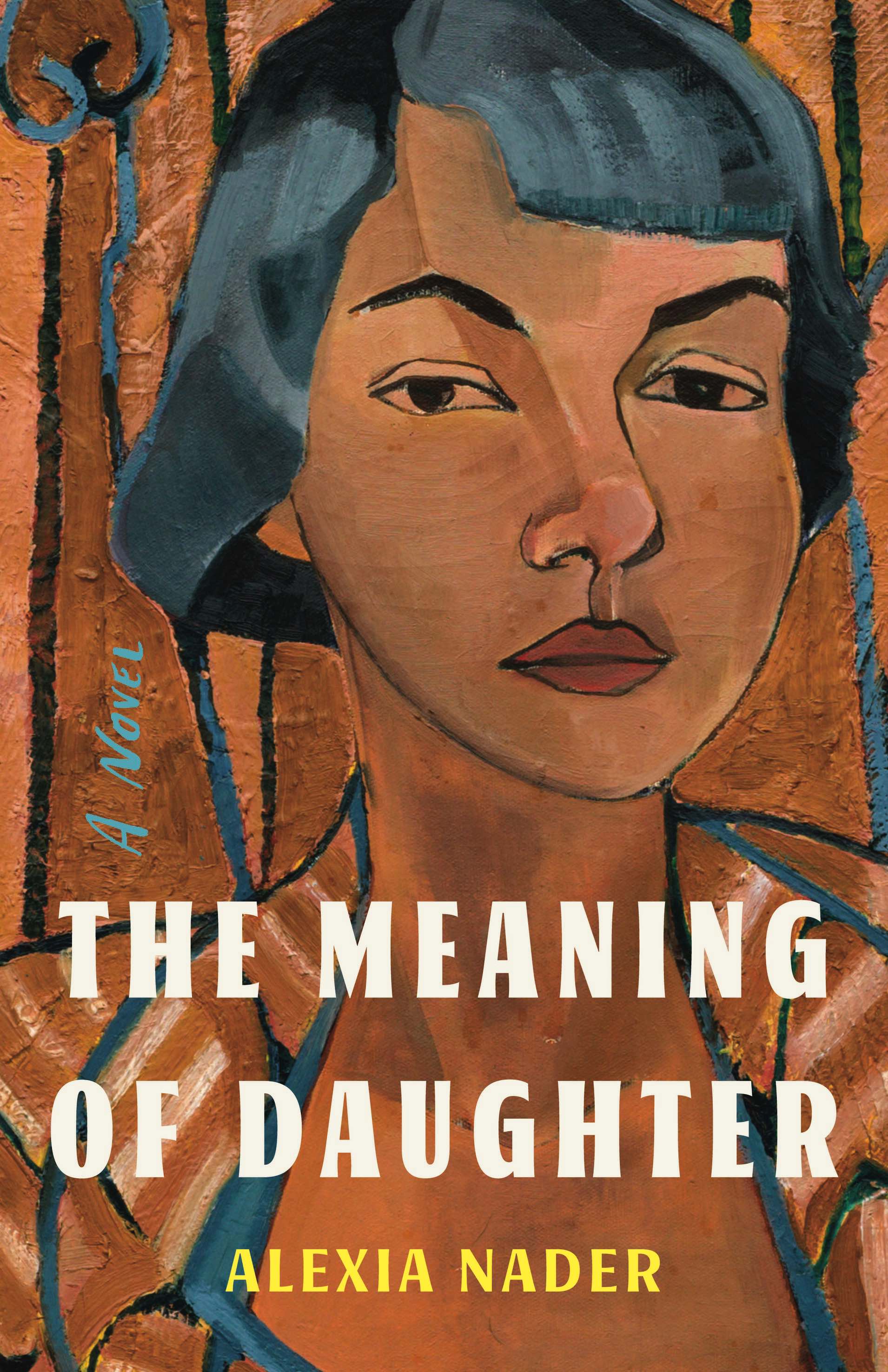
Alexia Nader’s debut novel, The Meaning of Daughter, packs a sweeping saga spanning three continents and as many generations into one modern, slim volume. The novel is broken into three sections, each chronicling one character’s journey towards self-actualization and self-acceptance amidst an evolving landscape of systemic oppression.
Merjan starts the story: an elderly woman on an airplane leaving her past behind her to live and make amends with her adult daughter. Merjan’s tale is quickly retrospective as she narrates her childhood migration from Lebanon to Haiti, her marriage as a means of seeking safety, and her reluctant motherhood. Merjan embodies several fraught identities – Arab, migrant, daughter, wife, daughter-in-law, mother, muse. But at her core, she is only and ever an artist. She is perpetually “other,” misfitted and relegated to noticing and wondering. Merjan’s narrative voice is rich with the keen observations of a painter:
I wanted to map this memory before it succumbed to another, before shapes settled into foundations. I could see the frenetic curves of the plaintain trees, laden with fruit, four zonbi dragged by a woman with a rope in the open land behind the plantain grove, and behind that a small, lonely house that grazed the ground so lightly it could almost be floating, and next to it an empty pen.
Merjan seems to see everything, thus making the novel’s inquiry all the more poignant: can she see her own children?
Yvonne is Merjan’s second child and the novel’s second narrator. Yvonne lives in New York, where her parents sent her as a young adult to take over the Haitian art business that her father, Ibrahim, ran since before Yvonne’s birth. Yvonne’s story involves a complex interplay of objectification and empowerment, as well as profound layers of ambiguous grief. Soon after her arrival in New York, she engages in a sexual relationship with an older, married, wealthy man, who affords access to connections within the art dealing circles that Yvonne is meant to navigate. While consent is not overtly called into question, the relationship’s power dynamics are palpable. Within this power imbalance, Yvonne nonetheless experiences desire, and learns to possess and utilize her own agency. The relationship represents the first of several steps Yvonne takes towards building a life on her own terms, severing ties with her family’s expectations of her, and rejecting many of their cultural norms. Despite this liberation, Yvonne’s narration is tortured by an abandonment wound. She grieves many lost, loved and wanted pregnancies. She grieves her greatest longing: to be loved and wanted by Merjan.
The final section is narrated by Eva, Yvonne’s daughter. Eva is an artist, like her grandmother. Her father, Yvonne’s husband, is Black. Eva’s multiracial identity reads like an extension of Merjan’s felt otherness: Haitian and not Haitian, American and not American, Black and Arab. Eva is pregnant when she is introduced in the novel, and her narrative grappling reflects an unease shaped by both ethnic marginalization and economic privilege. Her pregnancy was unplanned, and she is trying to figure out if it’s unwanted. Eva turns to her grandmother for answers that, ultimately, are not available.
All three of these women crave healing and connection, a shared reality. In Nader beautifully explores the dichotomies daughters are up against as we find their way and claim our own narratives: collectivism versus individualism, belonging versus othering, then versus now. Ultimately, the novel examines how significantly our identities are defined by the way our mothers see or don’t see us, and whether intergenerational repair is possible.
The Meaning of Daughter by Alexia Nader
University of Iowa Press, 2026, 300 pages, $24.99 [paper]
ISBN 978-1685970833
Edith-Nicole Cameron (she/they) reads, writes, and mothers in Minneapolis. Her poetry, essays, and short fiction appear in various journals, including Literary Mama and River Teeth’s Beautiful Things.