
 Review by Justine Pechuzal
Sadiqa de Meijer’s essay collection In the Field begins with loss—that of a writer’s cherished notebook—and thus frames a series of investigations into the finite. The scope is broad: from a medical student questioning the constraints of modern healthcare, to a Holocaust victim’s perception of humanity “[Etty] … possessed such a presence that even within a nightmare she could see the world,” (158) de Meijer observes and probes the world with laser-sharp finesse. Who are we? Where do we belong? How do we make meaning?
Much of what de Meijer finds is unsettling. Returning to her Amsterdam birthplace in the essay “Dwaallichtjes,” de Meijer learns her registration certificate, the equivalent of a birth certificate, names her as ‘foreigner’. When de Meijer, a former Dutch citizen, questions the categorization, a clerk explains that at birth, children are assigned their father’s nationality. De Meijer’s father was Kenyan. There is a logic to the answer, but at what cost?
De Meijer continues to wander the city’s landmarks, a ship replica at the Maritime Museum whose hold once contained slaves. She returns to her hotel, once government offices, and before that a hospital, examines decorative nods to Islamic culture sprinkled throughout the streets such as painted tiles and a Turkish lamp. A national election looms, the country is divided over how to manage refugees. And there continues de Meijer, exploring the grounds where she once did and did not belong.
In the hands of many, such subjects might fall heavy, but de Meijer, Poet Laureate of Katarokwi/Kingston, author of two poetry collections and the award winning memoir in essays alfabet / alphabet, uses language like a weaver of silk. Describing her fieldwork as a biology student, de Meijer writes, “To draw up a the net and examine what it held was a gesture that hovered between work and a return to the fertile mud of childhood” (50). The essay goes on to question the purpose of cataloging non-human species, the ethics of stunning fish for counting and the invisibility of Indigenous presence.
Loss, it turns out, is more commonplace than we care to admit. Humanity, environment and culture bear the marks. De Meijer possesses the courage to shine a compassionate light upon its many forms, encouraging the reader to do so as well. We are rewarded for our efforts, for as de Meijer describes her daughter learning to write “So the first writing is recursive; momentarily, it tricks the endless forward line and circles back, hovers protectively over the present, then makes a loop that can hold it” (15). The act of noticing loss, containing it with attention, makes way for forward movement.
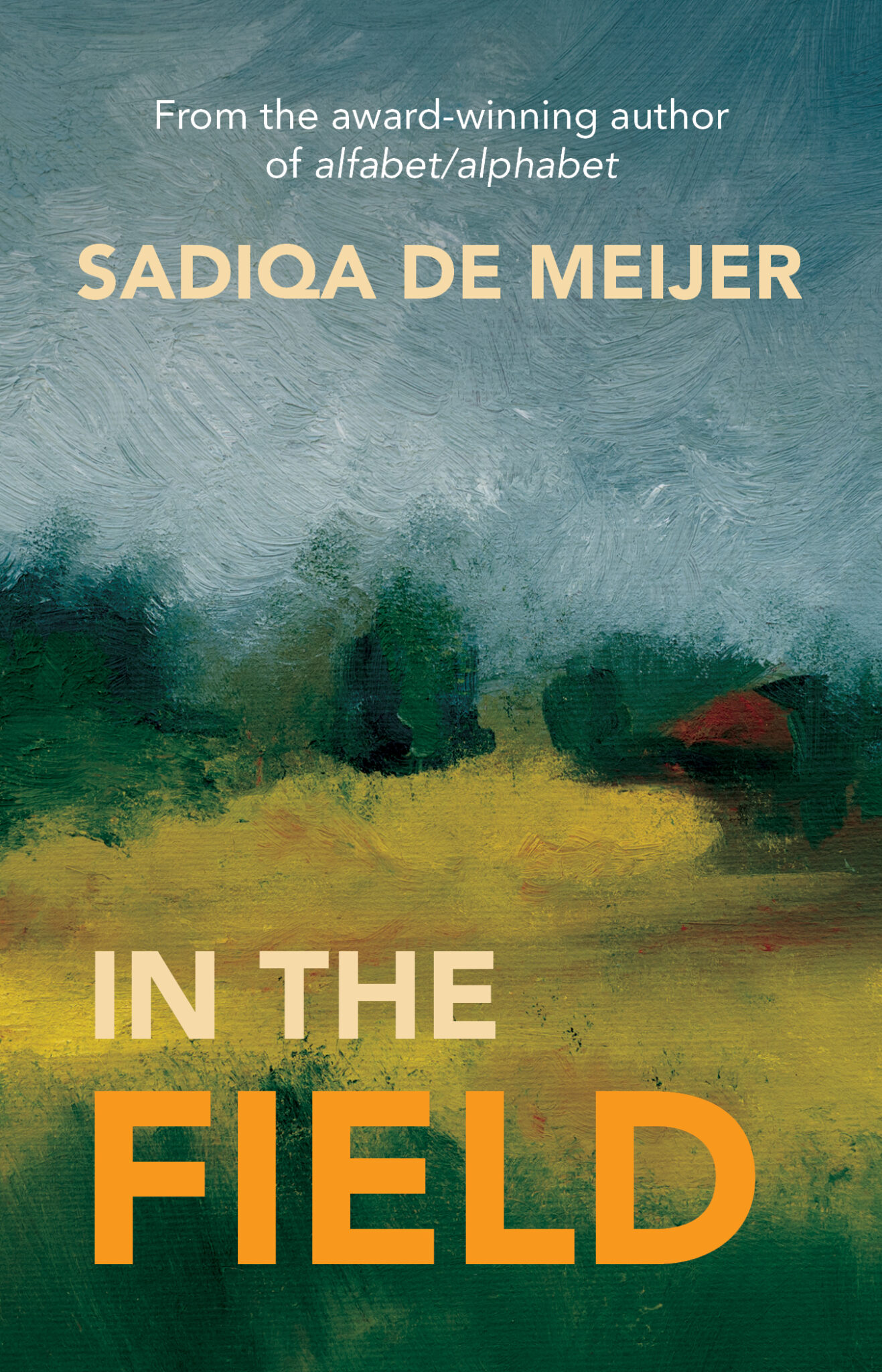
In the Field by Sadiqa de Meijer
Palimpsest Press, 2025, 169 pages, CAD $21.95/ USD $21.95 [paper]
ISBN 9781990293993 (softcover)
Justine Pechuzal is an artist, writer and educator living in Seward, Alaska. Her words and imagery carve a landscape of emotion that question the relationship between place and identity. Her work has most recently appeared in Gyroscope Review, AK Humanities Forum Magazine and Cirque Journal.