
 Review by Mary Ellen Talley
In much of the world, the summer heat of 2026 has been oppressive, pressing down like an ugly metaphor. How can we cope? First, it helps to identify the challenges. Doubly wonderful when a poet such as Judith Skillman takes the lead to explore varied forms of oppression.
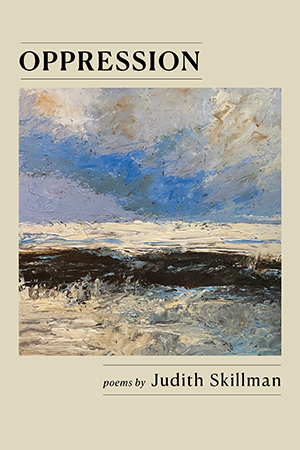
Her most recent poetry collection, OPPRESSION, gathers history, mythology, Jewish ancestors, family matters, and her own experiences to create moving free verse poems.
This Northwest poet sets the scene in section one, “For Darkness.” She creates images of sewing, weaving, and fabric in the poem, “Penelope’s Address,” a poem in the persona of the goddess of Spring who experienced oppression, “Like a statue, my ivory hands benign / as myth, my task ennui. Lift another skein // from its wooden hook, imagine him alive” (28).
Skillman’s precise vocabulary tethers her metaphors, as in “Remnant,” which recalls a Jewish childhood surrounded by relatives who survived the Holocaust. What remains is a bit of nostalgia, “the paisley linen / I made into next / day’s miniskirt” (18). This teenager, bullied by students, sewed to Motown music with her oppressed immigrant mother oblivious to her daughter’s pain of being an outsider.
Section two, “Hard-Wired,” depicts colorful relatives. The speaker remembers her teenage self who dismissed those elders with disdain. But Skillman is a master at lightening up heavy themes by making us chuckle, as in “Tenderness for the Old.” Following a picturesque introduction, the adult acknowledges:
Perhaps worst of all my sins—
trying to escape the grasp of Bubbe
when she grabbed my head
and spat on it to bless me
and keep me from harm (36).
Here is a seasoned adult appreciating that Jewish relatives suffered oppression in Germany and even after immigrating to supposedly safer countries.
With section three, “Long Hours,” poems turn inward with visualizations of chronic back pain causing disability. But in “Reflex,” the reader is offered a long-term perspective about how “the pendulum swings / between your wedding day / and the embalmer” (46).
Skillman smoothly shifts point-of-view in poems, as in “Long Hours of Illness.” She uses nature to soften pain with beauty, “I have spent alone, listening / to the spring birds sing and talk / to one another” (47). The poem ends with the speaker, like a peasant:
hoping to find sustenance
in glacial till, to drink afresh
from irrigation channels long gone,
mired in drought.
In “Spinal Cord Injury,” Skillman’s voice is knowledgeable about ramifications of stifling pain. “We are like hidden pictures, books shelved in a library / between other books that tell pretty stories” (51). Pain is often an oppressor and/or a precursor to oppression.
In a splendid modern sonnet, “Subsistence,” Skillman begins, “On a farm called pain I wake each day / and each day the same call whistles from slits / and clefts in this body given by the Lord” (50).
Poems consider possible oppression from nature, climate change, and the future in section four, “Every Nerve.” In “Homage to Pain,” the speaker announces, “For it tells me I am alive. For it runs like a gold watch with a new battery.” Paying homage is healthier than complaining when “Its sharp-needled beak drills my left hip / like a woodpecker.” (73). Skillman’s poems give voice to those who endure pain. Her words sing off the page to at least a lyric respite.
Nature, beauty, and music predominate in the collection’s fifth and concluding section, “Contagious Spring.” While darkness returns in “The Time to Ask Questions Has Passed,” it is with acceptance and/or a dim optimism. This poet observes that even Leo Tolstoy’s Nikita with “Three toes gone from each foot, still he walks” (79). Oppression may remain, but it is to be endured with dignity.
In the final longer poem, “Always Gardening,” there is the twist of a wry perspective. “Perhaps I am an elder / about to become the tilted shin / of that relative from whom I ran as a child.” Judith Skillman’s lyrical poems remind readers of the sustenance obtained from art, as “Heavy with gravity / I remember the sonata I could once play / by heart.” OPPRESSION is a tribute to resilience, surviving, and thriving. As the sun sets low, this final poem ends, “I vow once more to let whatever lies beneath a soul trill / summer, summer, summer” (82).
Opression by Judith Skillman
Shanti Arts Publishing, 2026, $16.95
9781971191003
Mary Ellen Talley is a Washington state poet whose reviews have been published in journals such as Asheville Poetry Review and Crab Creek Review. Her poems have been widely published in journals such as Deep Wild and CIRQUE, as well as in anthologies such as I Sing the Salmon Home. Her chapbooks are Postcards from the Lilac City, Taking Leave, and Infusion.