
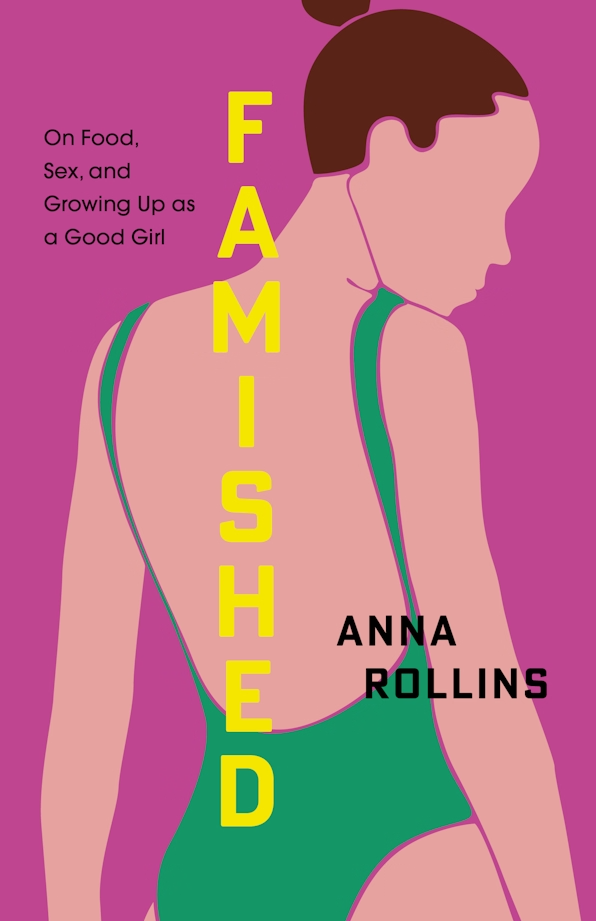
 Famished: On food, sex, and growing up as a good girl by Anna Rollins
Review by Melanie McGehee
In Famished: On Food, Sex, and Growing Up as a Good Girl, Anna Rollins examines the influences of purity culture and diet culture. Combining a personal narrative rooted in fundamentalist Christianity with psychological research and interviews, Rollins reveals a larger pattern, which she states near the end of her preface: when women worked to heal from body shame, their relationship to religion was intricately involved.
The book opens with two scenes separated by fifteen years. In the first, a teenage Rollins worries about exercise and calories while unconsciously bingeing granola bars and muffin tops in her family’s kitchen. In the second, her infant son is in the NICU while Rollins calculates the calories in pasta Alfredo and wrestles with urges to purge and exercise. The juxtaposition makes clear that this is not a story about a season of struggle but about patterns that followed her into adulthood. When a therapist later suggests that beneath her symptoms lies profound anger, Rollins begins examining the beliefs and systems that shaped her and finds that many center on control.
One of the memoir’s greatest strengths is its vivid scene work. Rollins recreates the atmosphere of evangelical girlhood in the late 1990s and early 2000s through catalogs, youth group teachings, Christian weight-loss programs, purity books, television shows, locker-room conversations, and family interactions. Rather than relying on broad cultural critique, she allows readers to inhabit specific moments. Particularly effective are the passages in which intrusive thoughts emerge on the page. In these scenes, readers hear the calculations, warnings, and compulsions that accompanied Rollins through much of her life. The result is a portrait of disordered thinking that feels immediate rather than explained from a distance. Reflecting on her fascination with stories of eating disorders as a teenager, Rollins writes, “Perhaps I was drawn to disappearance because that is what I, as a woman, had been taught to do.”
What impressed me most, however, was the memoir’s restraint. Rollins does not reduce her parents, pastors, or faith community to villains. She presents scenes and conversations with care, allowing readers to witness the messages she absorbed without presuming motives or assigning blame. This approach gives the book a complexity that many deconstruction narratives lack. Rollins is willing to examine the harm she experienced while also acknowledging the people and communities that shaped her.
Perhaps the book’s most surprising feature is that it is not ultimately a story of leaving Christianity. While Rollins critiques aspects of evangelical culture that contributed to body shame, fear, and disconnection from desire, she continues to identify Christianity as home. In an era when many memoirs about evangelicalism culminate in departure, Rollins charts a different course. Her questions are not whether she can leave Christianity but whether she can remain while disentangling faith from the messages that distorted her relationship with food, sexuality, and self-worth. The memoir therefore becomes not only an exploration of recovery from disordered eating and purity culture, but also an inquiry into what it means to remain in relationship with a faith tradition while questioning some of its teachings and assumptions.
The book does not offer a tidy resolution. Rollins admits that the mental calculations surrounding food and body image have not vanished entirely. Instead, she describes them as “radio static in my brain—some days the volume is turned up, other days it is turned down, and I cannot predict which days will be loud.” That honesty gives the memoir credibility and emotional weight. Rather than presenting recovery as a destination, Famished portrays it as an ongoing practice of awareness, compassion, and truth-telling.
Readers who grew up within evangelical purity culture will likely find moments of painful recognition in these pages. Although Rollins’s story is her own, the books, teachings, and assumptions she describes formed a broader cultural landscape that influenced many evangelical girls and young women. Those unfamiliar with that world may gain insight into the ways messages about faith, food, sexuality, and gender can become deeply intertwined. Through thoughtful reflection and carefully rendered scenes, Rollins offers a memoir that is both culturally specific and widely resonant—a story about hunger, certainly, but also about learning to inhabit one’s own life more fully.
Famished: On food, sex, and growing up as a good girl by Anna Rollins
Eerdmans, 2025, 240 pages, $24.99 [paper],
9780802884510
Melanie McGehee has an MFA in Creative Writing and loves leading online writing workshops, especially for women. She recently co-edited the anthology WRITE HOME: LETTERS TO A YOUNGER ME (Athenaeum Press, 2026). Find her at www.melaniemcghee.com