
 Review by Susan Blumberg-Kason
Most adults who grew up in the United States remember reading Highlights. Before the digital age, children around the country would peruse Highlights while waiting for a doctor or dentist appointment. The magazine is accessible to children of all ages, from the wordless hidden pictures to more complex short stories. Today the magazine’s foundation runs the Boyds Mills writing residencies for children’s storytellers in rural Pennsylvania. The founding of Highlights is truly an American success story, yet there’s an underlying sadness in the magazine’s history. Marty Ross-Dolen is the great-granddaughter of the founders, Caroline and Garry Myers, and while she’s a physician by training, she recently wrote a stunning memoir, Always There, Always Gone, that tells of her family’s inherited trauma that was rooted in a devastating accident from more than 65 years ago.
Ross-Dolen never knew her maternal grandparents, son and daughter-in-law of the Highlights founders. In 1960, her grandparents were traveling by plane from Columbus, Ohio to New York on business for Highlights. Their TWA plane collided with a United plane, crashing into Park Slope, a part of Brooklyn familiar to many in the arts today. Everyone on both flights perished. Ross-Dolen’s mother was only fourteen years-old when her parents were killed. As Ross-Dolen shows in her memoir—told through short, poetic chapters—ramifications from this crash carried on for decades.
There’s something extraordinarily tragic about plane crashes because unlike other fatal accidents, these accidents often leave loved ones without any type of closure. What occurred during their final seconds before the planes collided and crashed? Did their loved ones know what was happening? Did they feel anything when it happened? Ross-Dolen set out to find out more details of the crash, from her grandparents’ seat assignments to the place on the plane where the collision impacted their flight the most.
Some of the more harrowing parts of her family’s story after the crash include a chapter where Ross-Dolen worries about her parents boarding a flight while leaving her with a stranger from a babysitting service. There is also a time when her mother panics and tries to prevent Ross-Dolen from boarding an airplane because she’s worried she will suffer from the same fate as her parents. Milestones are treated with suspicion, too. For example, when Ross-Dolen turns fourteen, there’s an ominous aura in her home.
But I remember a feeling of foreboding on the day I turned fourteen, and although I don’t recall discussing it, I imagine my mother did too. Her parents were killed only two weeks after her fourteenth birthday, so wouldn’t it make sense for my destiny, for her daughter’s destiny, to be the same? I blew out the candles to a wish that might have involved a grade on an algebra test or a secret crush. But deeper in my heart I began a state of breath holding that would last the whole of a year.
Ross-Dolen’s book is not just exemplary for her masterful storytelling, but also for the photos and documentation she includes to provide more texture to her family’s story. The many layers of inherited trauma are present in her memoir and it’s a story that will stay with readers for a very long time.
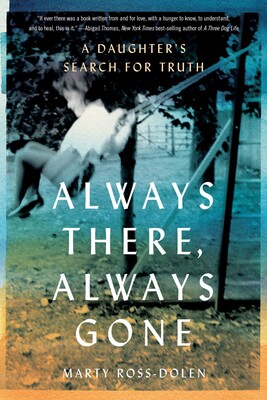
Always There, Always Gone by Marty Ross-Dolen
She Writes Press, 2025, $19.99
ISBN 9781647428914
Susan Blumberg-Kason is the author of a memoir and two biographies, with a third on the way. She co-edited an anthology of noir stories set in Hong Kong and is a regular contributor to Asian Review of Books, World Literature Today, Cha: An Asian Literary Journal, and the Jewish Book Council.