
 Review by Carla Panciera
Jane Ward’s fourth book, Should Have Told You Sooner, is both a journey novel and an exercise in time travel. As one of the novel’s youngest characters wisely observes: “‘We tend to think of life as a straight line until we’re reminded it’s lines that sometimes fold back on themselves or go in circles and figure eights’” (198). That is certainly the case in these pages, where characters not only visit the past, but where they are forced to examine how events from that time that are beyond their control shape their present and their future.
The novel’s main character is Noel Enfield, a woman in the process of divorcing her husband of six years and trying desperately to maintain her role as stepmother to their teenaged daughter, Alice, whose biological mother left both Alice and her father years earlier.
It is a pain to which Noel is no stranger, as her own mother was killed in a car accident when Noel was nine, and she was sent to live with her grandmother. Thus begins a thread of abandonments, whether intentional or accidental, and the trail of devastation left in their wake.
When, during the earliest stages of the couple’s separation, Noel is offered a secondment experience which will allow her to live and work in a London art gallery for six months and then return to her job as Collections Director in a Massachusetts museum, both her future ex-husband and his daughter experience a pain and anger that must feel impossibly familiar to them.
This isn’t the first time that Noel is forced with the kind of choice that confronts so many women: to live their lives as their own dreams and ambitions dictate, or to sacrifice their goals in order to facilitate their childrens’. But Noel is blessed (or cursed) with a quick decisiveness. She may regret the choices she makes, but she wastes little time in making them. She heads back to London where another part of her past is about to loop into the present.
Thirty years earlier, Noel attended school in London where she met Bryn Jones, a young and already talented Welsh painter, who recounted for her the most well known Welsh folk tale about Nelferch, the lady of a lake called LLyn Y Fan Fach. Nelferch falls in love with a mortal even though she can’t live outside of water. Bryn insisted that Noel understood what it was like to live between two worlds and asked her to model for him as he tried to capture Nelferch on canvas. The two fell in love. When Bryn was offered a fellowship in Italy for a semester, however, Noel’s deepest fears were realized. If one’s mother could walk out of one’s life, why not a beloved?
Meanwhile, the painting would go on to launch Bryn Jones’s career as an artist who would become famous for “landscapes . . . where the real world met the folklore” and where “sometimes Noe’s face or outline appeared in them” (71).
Once Noel returns to London, the memories of that relationship and its aftermath haunt her, especially when, in her role as one of the team members arranging the exhibition for the UK Rising Artists Awards, she is introduced to the paintings of young Henry Bell, whose “gritty and man-made landscapes . . .overwhelmed her with that same feeling of loss [as Bryn Jones’s], this time the loss of people destined to look but not touch, or perhaps touch, but not know—people trapped behind glass instead of water. Perhaps because she was familiar with loss, she found it everywhere” (113). Within the next few months, she will not only have to confront Bryn and the truth of what happened to separate them, but she will also have to reveal to him a secret that may divide them forever.
Ward’s novel, via the story of this couple, illuminates those moments in a person’s life when one unexpected deterrent intersects with a person’s deepest fears. Despite her grandmother’s practical care, her own successful career and role as a step mother, Noel Enfield will always be an abandoned child, convinced no happiness can last. Within that framework, she makes the biggest and most regrettable choice of her life. All these years later, she must confront the result of her actions, accept the timeline of her own life looping back to catch her up in its twists and turns. But, as her old friend assures her —and, possibly, the reader—“‘You got right here, right now by living your life, your most unexpected life, with its every up and every down . . . Everything you did and didn’t do brought you exactly here. To something good.” (308).
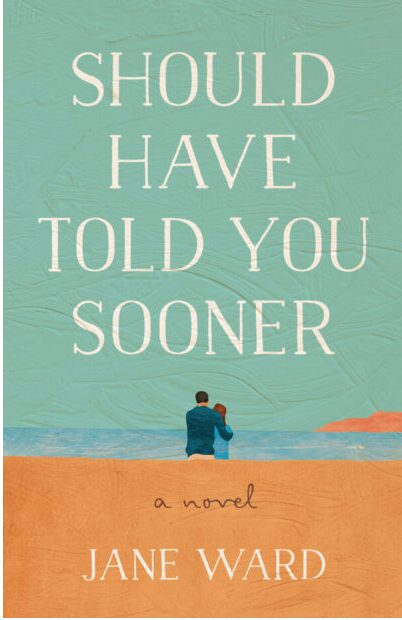
Should Have Told You Sooner by Jane Ward
She Writes Press, 2026, $17.99 [paperback]
ISBN # 979-8-89636-066-7
Carla Panciera’s poetry collections include Cider Press Award Winner, One of the Cimalores, Bordighera Press Award Winner, No Day, No Dusk, No Love and most recently, One Trail of Longing, Another of String (also Bordighera). Her short story collection, Bewildered, received AWP’s Grace Paley Award and was published by the University of Massachusetts Press. She is also the author of Barnflower: A Rhode Island Farm Memoir.