
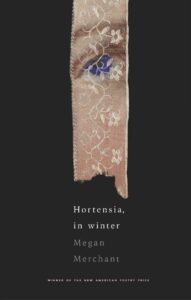
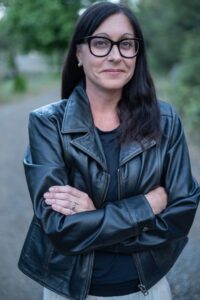
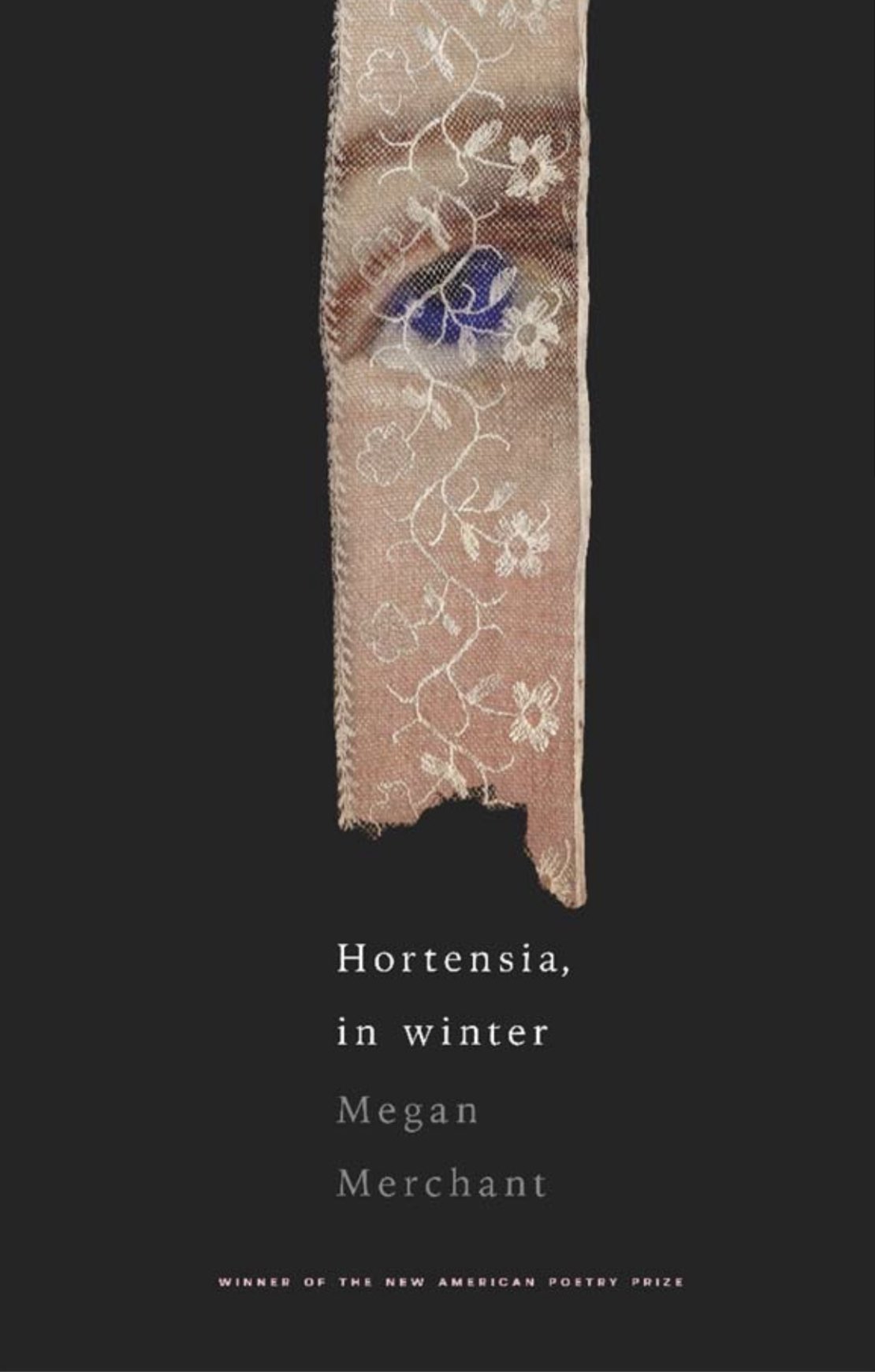
 Megan Merchant, Author of Hortensia, in winter
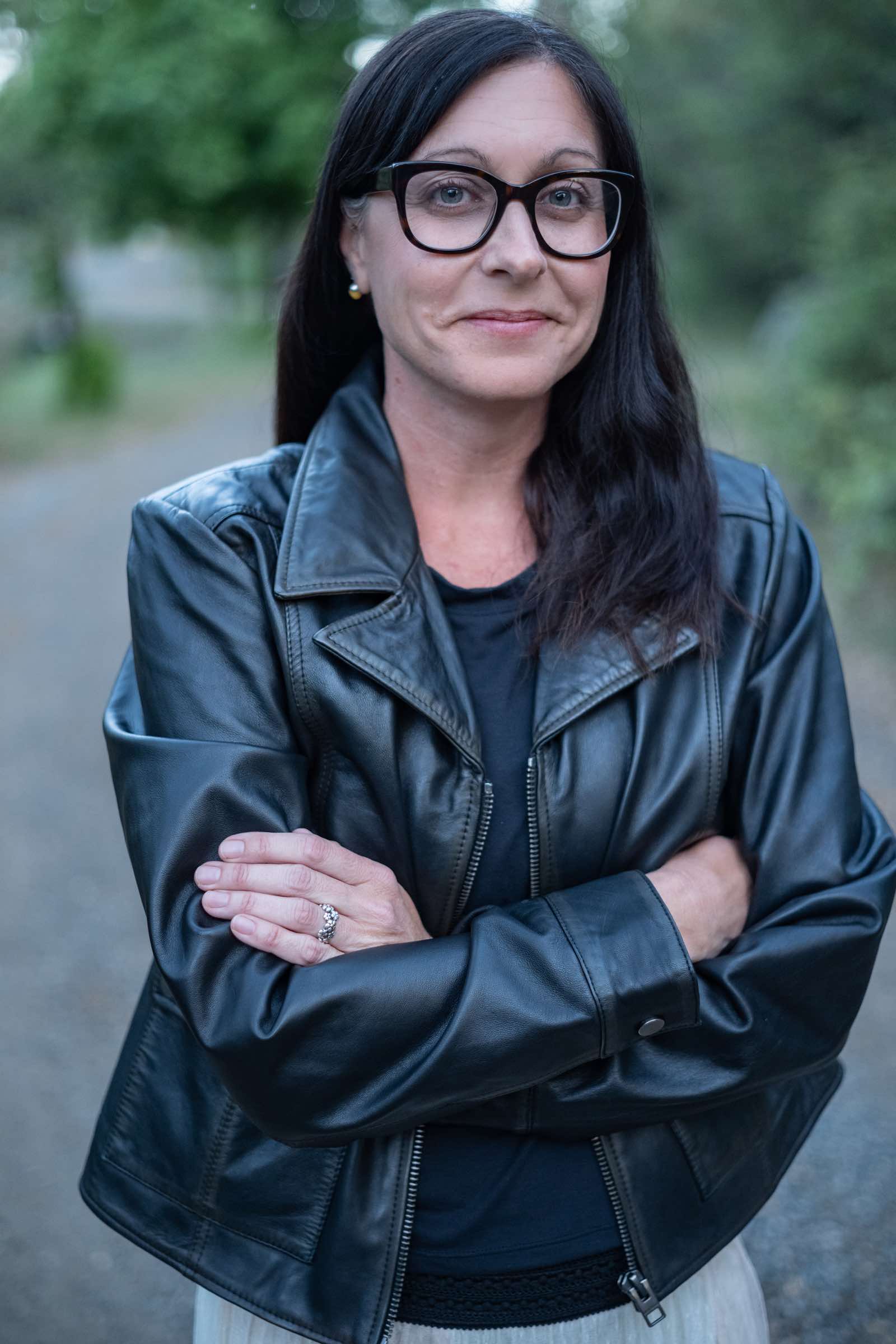
Interviewed by Melissa Joplin Higley
MJH – When and why did you first start writing poems?
MM – I was an odd kid and instead of writing diary or journal entries, I wrote poems. Looking back, they are very endearing and hilarious. However, it wasn’t until undergrad that I gravitated toward poetry as an intentional art form. Despite the loud warnings that I could never make a career path from poetry, it was the thing that made me feel the most alive.
MJH – Who are your main poetic influences?
MM – The night TVs flickering in the windows of houses I run past. The root systems that poke through the forest floor on a path I like to hike. A catch of conversation with someone I care deeply about. A painting that hangs in the studio where I create—that swirl of ink that feels bottomless. While I am constantly studying craft and reading contemporary poets, looking for poems that move and challenge me, I have recently tried to let my everyday world do some of that work. I have stories about how Anne Sexton changed my artistic path several times and am obsessed with Nick Laird’s poem “Incantation”. I have also been trying to find poems that aren’t just living inside of books, but in visual arts, nature, music, conversations, engagement with my children—even in the struggles and obstacles that I encounter. In this way, I am not mining from my life to create poetry as a removed and separate thing, but an interconnected and present experience.
MJH – How would you describe your work, as it has evolved over time?
MM – I see how my poems have shifted from (a small bit of) narrative / into devotional lyricism / into fragmentation. This is a mirror that shows how I have grown as human. It is also a reflection of the environment (cultural / political / personal) that shapes my perceptions and poetic preoccupations. Mostly, though, I have learned a lot about how to revise a poem without outside advice, or the mixed bag suggestions that are fun to try but fail to offer clarity, replicability, and confidence. Developing a strong revision practice has allowed me a lot of freedom during the creation stage. I know that I can take risks, play with form and the container, wildly veer, and still have a place to come back to that pulls it all into alignment.
MJH – What inspired you to write this book?
MM – A few years ago, I was gifted my grandfather’s letters home from WWII. They were wildly disorganized, written on wax paper, in pencil, and in cursive. In other words, they were an alluring and frustrating puzzle. My father and I spent about four years transcribing them, decoding my grandfather’s rushed handwriting, maneuvering around redated cutouts, all the while streaming together a timeline. At one point, I found a single letter that did not match—the tone was radically different. It dove into faith and a solitude that echoed being stranded in a desolate winterscape, hoping for any word from family. After research and help from family members, I uncovered that it was my grandfather’s great-grandmother, Hortensia. She travelled with Joseph Smith, helped to establish Nauvoo, IL, then left everything that she knew and valued behind to escape polygamy once Brigham Young came into power. I was fascinated by her and the letters that I was able to locate. Given that most women’s voices mute into obscurity—I was in shock that hers still rang out in the form of the written word. I knew that I needed to commune with her and that part of my ancestry. I had a hunch that there were vital lessons waiting for me there.
MJH – How did you determine the voice and form these poems would take?
MM – Given that I was addressing a voice that could never answer, coupled with the way that it echoed deeply into my own life, questions about love, faith, and history, I knew that I needed a sturdy container. I sought one that would be able to hold those questions without letting them thud or stream into endless whitespace. I chose prose blocks for every poem, knowing that it was a safe container for poems that dwell in emotional intensity and lyricism. This also allowed me to free up my own voice and enter that space as authentically and vulnerably as I could. I knew that what I had to share would be held.
MJH – What were the challenges when writing this book and what did you learn from the process?
MM – I had to negotiate with fear and time. For a solid month, I locked myself in my office every morning for a few hours and wrote. I showed up daily despite the potential of having nothing valid or interesting to say, the fear of diving inward, and what I might find waiting there. There was also the strong chance that I would emerge with a disjointed mess of poems that would never see daylight. I took time away from editing and mentoring to hear my voice, sit with my own preoccupations, and listen deeply inward. In order to invest in myself, I lost outside income and sectioned off my most valuable resource—time. Given all of the roles that I play in life and the amount of energy that is dispersed outward, it felt risky to prioritize my own creative ambitions and needs. I had been working in the smallest spaces between everyone else’s lives and demands. I had been mothering, householding, working, partnering, and caretaking the entire time that my other books were written. That engagement and production was almost secretive. This time, I did it differently and showed up despite the fear. I learned that my own needs aren’t going to be met unless I act and advocate on my own behalf. I also learned that what was lost, when I removed the support beams of my time and energy outward, wasn’t stable to begin with.
MJH – How does this book fit into the scope of your other work? Is it a progression, a diversion, or something else entirely?
MM – My work shows a marker of who I was at the time and in that space. This book is different in form / container (epistolary and in prose blocks), but the tone, love affair with imagery, and lyricism are pretty on par. I am usually writing to an audience of one (the reader comes into mind during revision). It wasn’t until after I was done with readings and promoting this book that I was able to sit with the poems and see them for what they are, not what I intended them to be. I found that I had been writing to myself. That clarity, once understood, was astounding. I was moved and grateful (and continue to be) for the ways that poetry reveals us to ourselves. I found, in those poems, that I had created an emotional map that reached deeply into my own world.
MJH – What are you working on currently?
MM – I am working hard on a book of essays about a poetry revision methodology that I created, currently titled “Honoring the Wisdom of the Poem”. It will be published by Black Lawrence Press in 2027.
MJH – How do you structure your typical workday?
MM – I often joke that time is a construct that I don’t participate in because there is no typical in my world. Daily, I am raising two children as a single parent, mentoring poets around the world, editing, writing a book, producing visual art in my studio space downtown, maintaining a running practice, spending time in nature, and working to include the things that bring joy into my world. Every day is structured differently. It is organized chaos. I will admit, though, that I don’t sleep like an average human does and oftentimes find myself writing in my dark kitchen at 3am. Either that, or dancing with headphones on.
MJH – What’s the most interesting thing you’ve read or heard recently?
MM – “Feeling is a way of knowing what you’re going to think about something. Example: I felt the thought, I could want you. Emotion as premonition. It is a mystery. It is the ideal form of beauty.” (Rebecca Lindenberg)
Eye, Barb, Throat, Gap
Would it be fair to say that the body is a causeway, an agenda of
leaving at low tide? Leaving always. I’ve come to worship at the
wrong house, again. Too many mirrors. Desire doesn’t like its
reflection, the way it shimmers. A tell. The way he said, there’s
something going on with you, and we both meant him. Some
fishermen can’t help but cut the eyes out after the reel and pummel.
A facsimile of clouds as cornea. Burst from being drawn to the
surface. What happens when light reaches the unsayable, the
phantom pain of the hook. There’s something. Water isn’t a safe
keeper, unless what you are offering is meant for the dark.
From Hortensia, in winter
Read our review of Hortensia, in winter
Megan Merchant (she/her) is the owner of the editing, manuscript consultation, and mentoring business Shiversong (www.shiversong.com) and holds an M.F.A. degree in International Creative Writing from UNLV. She is a visual artist and the author of six full-length poetry collections: Gravel Ghosts (2016, Glass Lyre Press), The Dark’s Humming (2015 Lyrebird Award, Glass Lyre Press), Grief Flowers (2018, Glass Lyre Press), Before the Fevered Snow (2020, NYT New & Noteworthy, Stillhouse Press), A Slow Indwelling (2024, Harbor Editions) and Hortensia, in winter (2024, New American Poetry Prize winner, New American Press). Her children’s book These Words I Shaped for You is available through Penguin Random House. She was awarded the Las Vegas Poets Prize, the 2016-2017 COG Literary Award, judged by Juan Felipe Herrera, the 2018 Beullah Rose Poetry Prize, second place in the Pablo Neruda Prize for Poetry, the Inaugural Michelle Boisseau Prize, was a finalist in the 2024 Montreal International Poetry Prize, and, most recently, won the New American Poetry Prize. She is a board member for the Northern Arizona Book Festival and the former Editor of Pirene’s Fountain. Currently, she is working on a book of essays about the poetry revision process that will be out in the world through Black Lawrence Press in 2027. You can find her poetry and artwork at https://meganmerchant.wixsite.com/poet