
Tatiana Johnson Boria
Saturn
After each visit to your grandmother’s group home, over the past two decades, I’ve learned the art of capturing. Of forcing my mind to remember my mother in all of her dimensions. I use these memories to fill in the gaps her absence. The months on end where I can’t reach her or can’t visit because of distance and not having the strength to. I use pictures to aid my remembering, just as I do to capture your growing. I scour my aunt’s attic and find images of my mother from before I was born. Like this one photo of your grandmother in Elizabeth City, North Carolina, when she was a kid. Or the one of your grandmother smiling while wearing a Chicago Bulls hat, the one she’d wear most often when I was a child. These are the photos I’ll use to show you so that you can know who your grandmother is, was, or how I want to remember her. If I must build my own universe, these photos are a dimension in which I want you to know her. This is how I fill the gap of you both never meeting, the gap of your grandmother being alive but always vanishing.
In my favorite photo of your grandmother, she’s all sass. She’s a teenager and the epitome of the 1970s. Her afro, glorious. She’s in yellow form-fitting jumpsuit and white platform shoes. She looks like Saturn, a golden orb, with a circle of friends surrounding her. So different than how she is now, alone in the basement in her group home. She was once a magnet. In this photo, I tell myself a story: your grandmother is on the way to a party with friends, on the way to dance herself into being. She’s alive and uncaring, in the best way possible. I am there with her. I know it’s impossible, but this is what I’ve drawn up. Your grandmother spots me beyond her friends. She looks at me as if she knows me but can’t quite place me. She walks over to me and smiles, fixes my hair, picking it to mimic the volume of hers. She tells me who she plans to dance with. I don’t tell her I plan to dance with her, that I am just happy to be here.
She introduces me to her friends. The one in the powder blue suit. The other in the black dress. She teaches me how to pose. Eyes forward. Half smile. Shoulders back. The cobblestone bricks don’t trip us, even in our platform heels. It is nighttime and time is endless. We hear the music. The rhythm, deep and echoing. Inviting. I want to ask her; do you want to become a mother? Yet she’s already gone through the doors of the party. I watch her hips sway inside.
On a visit with your grandmother, I show her the photo I’ve found. It’s been more than 40 years since the photo was taken. In that time, she’s become a mother, gotten diagnosed with schizophrenia, took care of four children alone, and then lost custody of those four children. I watch her as examines the photo in disbelief, almost as if she, too, can’t believe how much life she’s lived since the photo was taken. She laughs. “Where’d you find this T—?” I don’t tell her about the story I’ve created in which I’m in the photo with her, closer to her than I’ve ever been. I watch her face twitch, maybe in remembering? Maybe because of a change in medication? She hands the photo back to me, as if she’s ready to put the memory back in the depths of her mind. I take it back home with me and keep it, along with some other ones. I hoard these versions of your grandmother, so that one day I can sketch her for you, so that one day you might be able to see her differently.
By the time you’re two-years old Saturn’s rings will disappear. You won’t know it as the one planet with circles surrounding it. You’ll come to know the planet differently and have your own ways of distinguishing it. Your grandmother lives inside my memory with her own halos, her own bands of light surrounding her. Her own ways of emitting both light and sorrow, both love and ruin. I am trying to capture her as she once was, because she is disappearing. From my memory, from our family, from her own self. I can’t stop myself from being an anchor, one that reminds her of the life before we were all separated, and the life that has not stopped happening since that severing.
There are theories to why I might feel this, this interconnectedness that I can’t seem to distance myself from. In African Psychology, or the understanding of the culture of Black Americans outside of Euro-American Psychology, they call this “oneness of being.” Or the idea that being alive, in the context of Blackness, means to accept “the collective and social sense of one’s history.” There is no individual without the collective, and I can’t help but think of mothering. How we all entered this world as a collective, with a sense of “oneness” with the ones who birthed us.[1] This is why I can’t build a universe in which I let your grandmother disappear, there’s a possibility that part of me will disappear with her. You must remember the alchemy that has brought you forth. The inability to separate where your grandmother, me, and you begin. It is through this void that you came forth, a life awaiting its own stories, memories, and relationships. A life your grandmother may not know of, but has already, held in her hands.
[1] Clark, Cedric X., et al. Voodoo or IQ: An Introduction to African Psychology. Feb. 1975, https://doi.org/10.1177/009579847500100202.
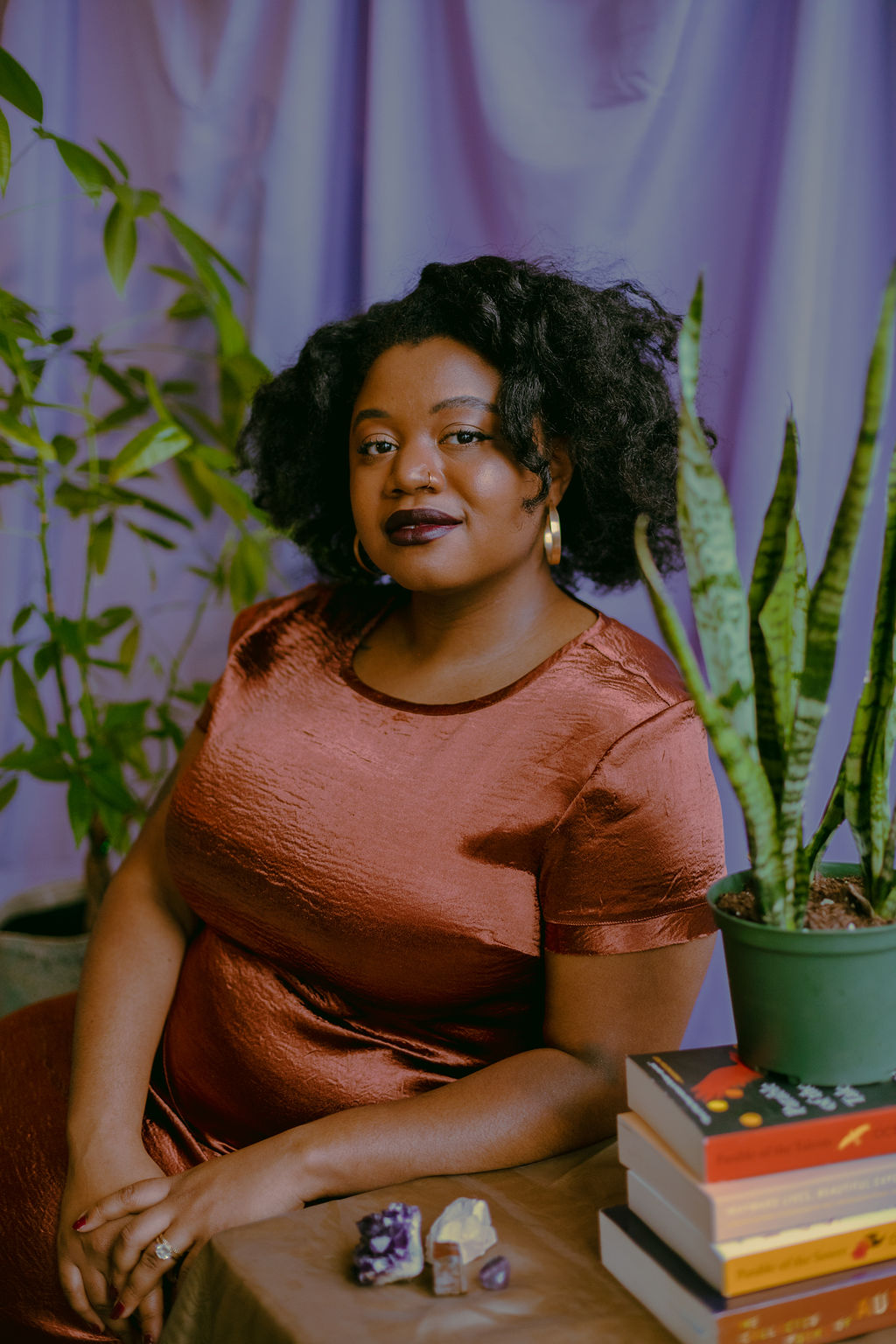 Tatiana Johnson Boria (she/her) is the author of Nocturne in Joy, winner of the Julia Ward Howe Book Prize in Poetry. She was raised in Boston, on the unceded land of the Massachusett people, and is an educator, artist, and mother. She’s received fellowships and awards from Tin House, the Massachusetts Cultural Council, The MacDowell Residency, among others. She now lives in Framingham, home to the Nipmuc people, with her partner and son.