
 Review by Tessara Dudley
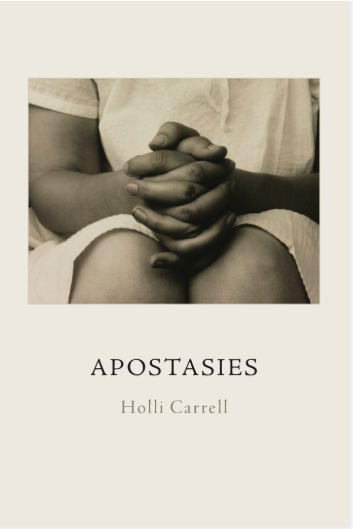
Holli Carrell’s debut collection, Apostasies, is the lyrical diary of an adult reckoning with the aftermath of a girlhood within the Mormon church. Though it is poetry, it draws on a variety of archives and published writings about modern and historical Mormonism, and combines them with a deeply personal and highly introspective examination of the heavily regulated existence of women and girls in the church.
The book opens with a retelling of Jephthah’s sacrifice of his daughter (from Judges 11: a man who makes a rash vow to God must sacrifice his daughter as a burnt offering to keep his word) and ends with a simple poem reveling in the isolation of a speaker floating in the ocean, entirely alone. In between, the book flows from constraint to freedom, revealing the many ways in which Mormon girls and women are restricted, directed, and controlled, and how it feels to escape. In “The Woman Next Door,” the speaker notes:
God was vengeful, I knew that.
The woman next door had seventeen
children, wild as crows. What had she done
to deserve boys who tortured kittens
and scrambled eggs on the hot sidewalk? (8)
The poem “Equine” likens girls to horses tamed in a paddock, and in “Womanhede,” girls are constrained and shaped by the clothes they wear: restricted to only wear clothing deemed feminine, and forbidden entry to the church building if they wore trousers. Their gender is always policed and surveilled: “She feeds the body scraps, / bathes it, applies makeup. // The flock watches and monitors” (19). This earthly surveillance is echoed by a kind of divine surveillance in “Confession,” where “I could not hide / because God / was always in my mind, listening” (108). In “Garments,” the speaker reveals that girls are taught to appear softly appealing for the gaze of men: “for protection against sin and evil, I must / look wife-worthy, unsullied, meek—like a celestial mother and / modest woman” (22).
In the sprawling piece, “Patterns,” Carrell compiles a combination of excerpts, erasures, and personal recollections all circling around the place women can hold in a church whose founder married up to 67 women and girls, aged 14 to 58 years old, pressuring many of them into these marriages:
“He saw how unhappy I was.” [Said]
“it is a command of God
to you. I will give you
untill to-morrow to decide
this matter. If you reject
this message the gate
will be closed
forever
against you.” (49)
The following poems are full of visceral and unsettling details: dreams and nightmares recounted with a kind of quiet desperation; the quiet joy of a post-church job marred by violence; a first sexual experience, pleasureless and dissociated; and contemplations about graves and maggots. Other poems grapple with religious teachings that tie women’s worth to motherhood, and losing friends for choosing childlessness. Still others celebrate the discovery of self-pleasure, and the simple freedoms found in gardening.
Overall, this book is a powerful tale of survival and finding joy after a repressive religious upbringing. There is fear and anxiety, but there is also recovery, and the chance to make of your life what you desire, beyond the strictures laid out by long dead men. While a decent background knowledge in the history of the Mormon church and culture can clue the reader in to the meanings behind a few of the poems, Carrell provides thorough and informative notes at the end of the book, and the vast majority of the poems can be understood by themselves.
An earlier poem laments the tendency of men to dress hunger and greed up in religious language, but concludes that “this is an American story after all” (6). I think the final poems, wherein the speaker shares a beer with a loved one in the shade of a tree and floats in the ocean alone, flip this negative on its head: to leave behind your tormentors and travel to new places; and to build a new life for yourself, defined by the freedoms you’ve won? This, too, is an American story, and Holli Carrell’s triumph over her past is one story to be celebrated.
Apostasies won the Perugia Press Prize for New Women Poets, and the Last Syllable Book Award, and was a finalist for the Foreword INDIES Book Award. Holli Carrell is currently working on her next book, this one about the 19th century Mormon colonization of Utah, and its lasting ecological impacts. She is currently the Assistant Poetry Editor at Acre Books.
Apostasies by Holli Carrell
Perugia Press, 2025, 142, $20 [paperback],
ISBN 9780997807691
Tessara Dudley is the author of Fallen/Forever Rising. Their poetry has appeared in Sun Star Review, Wordgathering, Lothlorien Poetry Journal, and Words Dance, and in anthologies published by Minerva Rising, Zoetic Press, Damaged Goods Press, and Wingless Dreamer, among others. They share poems, writing resources, and book reviews at http://tessaradudley.substack.com