
Review by Sharon Tracey
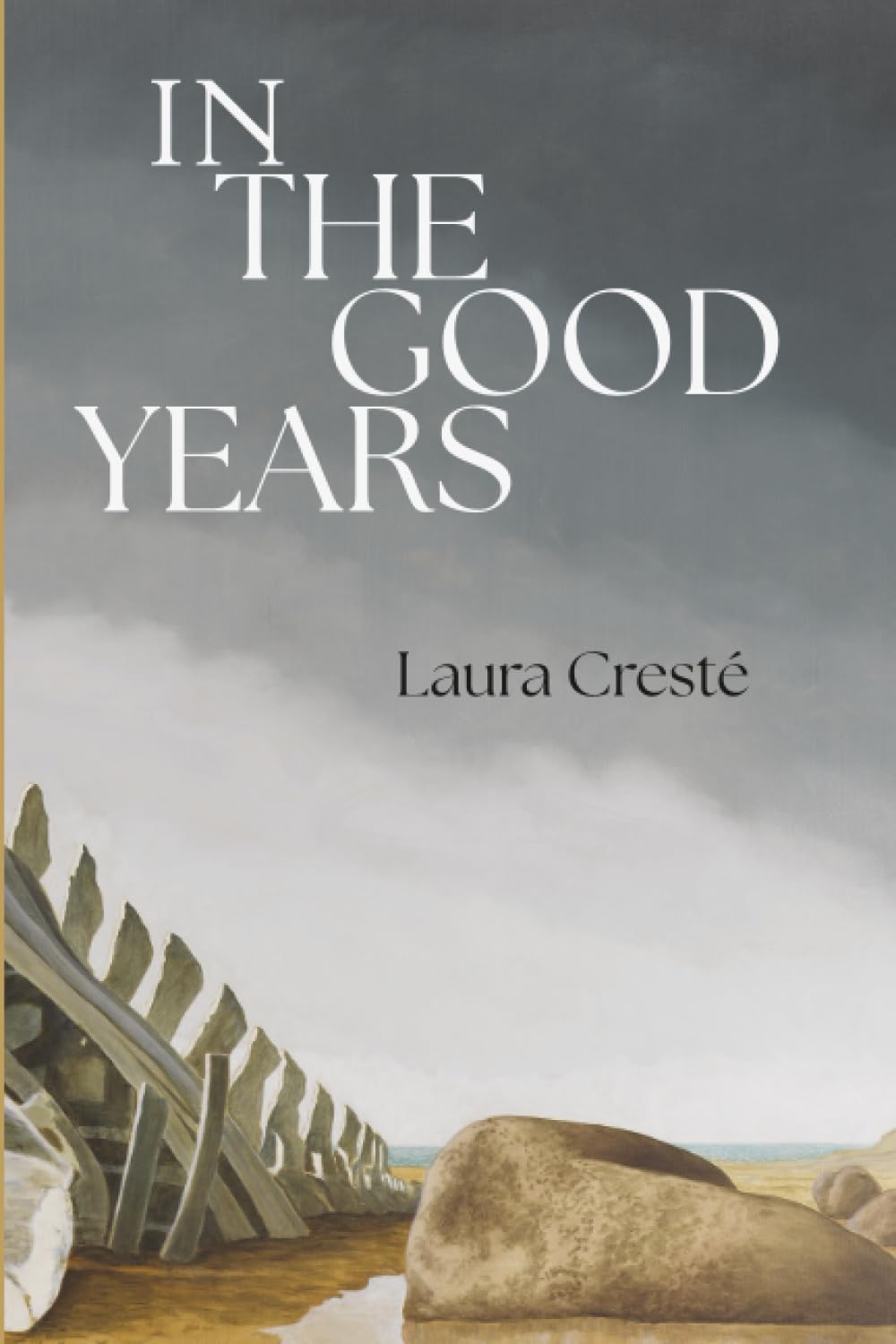
Laura Cresté’s first full-length poetry collection, In the Good Years, opens with dead horses and ancestors, garden slugs and chipmunks, and two feisty and devoted mothers. There’s an immediacy and honesty as the poet writes of the angst of growing up—mood swings, depression, sisterhood, a shifting sense of roots. Then she equally turns her attention to the larger world in an expansive rendering of the personal, political, and environmental, rich in the details of daily life but cognizant of how the self is a small part of the world and needs to find connections and meaning, be of some service. In these poems, Cresté charts a path, giving the dead and the living their say along the way as the poet learns, grows, and shares what she comes to know.
Cresté’s poetic language is vivid and evocative. In “Radius” (p 9), the poet writes about bones, her own and her ancestors: “The bony sounds—tooth box clatter, knee crack, / neck twist—remind me where I’ve taken my body.” She takes her bones to Paris (among other places), “stooped through the catacombs” … “Bones built of mother, marrow, star, and milk.” Bones she knows, beneath her skin and in the graveyard.
In “Fisherman’s Quarters” (p 30), in a dive bar where she once worked, the poet writes:
This was a whaling town, and we got them all. Melted the beasts
down for perfume and oil, wove the small bones into corsets.
You could use the whole animal, unlace your dress by what burned.
Perhaps not all. The ones who survived went deeper into the sea.
…
Fish: the same word for the subject and the violence done to it, like skin.
Humans, marine mammals, fish—the warm and cold-blooded alive with suffering and survival.
Just as surely, Cresté creates a vivid sense of place, as in “This Is Just To Say” (p 36), where she reveals that William Carlos Williams’ son was her pediatrician until she was four and he died, writing (p 37):
… I never saw chickens,
none that were living,
and the only wheelbarrow
was symbolic, red, chained to a tree outside the library.
We had plums in our yard
and crab apples,
until all the trees
got brown rot…
The poem “At the Lighthouse” (p 52) provides a sort of backbone for the book, a long grief poem—for a whale “starved / muzzled by fishing line, / and washed up at the base / of the lighthouse, as if it could try / its luck again on land. / Bristle-mouthed, blue-eyed, baby”—but also for the world, the “black, slick birds and melting ice,” the virus, “the weather we’ve made.”
In other poems Cresté explores categories of guilt: political, criminal, moral, metaphysical, and generational. Containers, the poet calls them, and one way to reckon with Argentina’s traumatic history. In “Calle Sin Cielo,” (p 73), the work of translating her aunt’s poetry collection becomes an entry point to a collaged prose poem which moves back and forth across time like a spirit ghost, giving voice to her aunt who was kidnapped and detained and to her own father as he shares his history, which in turn provide a mirror for the self. And the “what-ifs” linger as we learn her aunt Alicia was only twenty-five when “The soldiers took whoever was home.” (p 75).
Cresté has a fine ear and sense for how to switch subject and tone, counterbalancing the dark with light, offering “Socrates with Fleas” and “Egg Party” with a bit of humor and celebration even as small truths seep out. In the latter, she writes (p 96):
The spring my systems go wrong, I throw a party
where the theme is eggs. Chicken eggs deviled
and overburdened. Caviar held precariously
to potato chip by a slick of cream.
The idea is rebirth, claim whatever rituals
remain palatable. Spring of resisting
…
In the penultimate poem, “Poem for My Children Born During the Sixth Extinction” the poet addresses the Anthropocene—our time—and the world the young will be left with: (p 104)
We knew our children’s lives would get worse every year.
We thought they might like to be here anyway,
to know oceans, ice cream, optic nerves, the flowers and all their names.
Cresté leaves us with some hope. Then she looks back one last time in the final poem “Pokeweed” and sees herself as a child (p 106):
I don’t know if I was happy but here is where I was.
On the back stoop, hunting meteors with my father:
I was ten, it was winter, we could see our breath.
Like a life, In the Good Years is a book to return to.
In the Good Years by Laura Cresté
Four Way Books / Poetry 2025, $17.95 [paperback]
ISBN: 9781961897564
Sharon Tracey is the author of three books of poetry: Land Marks (Shanti Arts 2022), Chroma: Five Centuries of Women Artists (Shanti Arts 2020), and What I Remember Most is Everything (All Caps Publishing 2017). Her work has been published in Radar Poetry, Terrain, Lily Poetry Review, The Ekphrastic Review, among others. She previously served as a director of research communications and environmental initiatives at the University of Massachusetts Amherst