
 Review by Melissa Kutsche
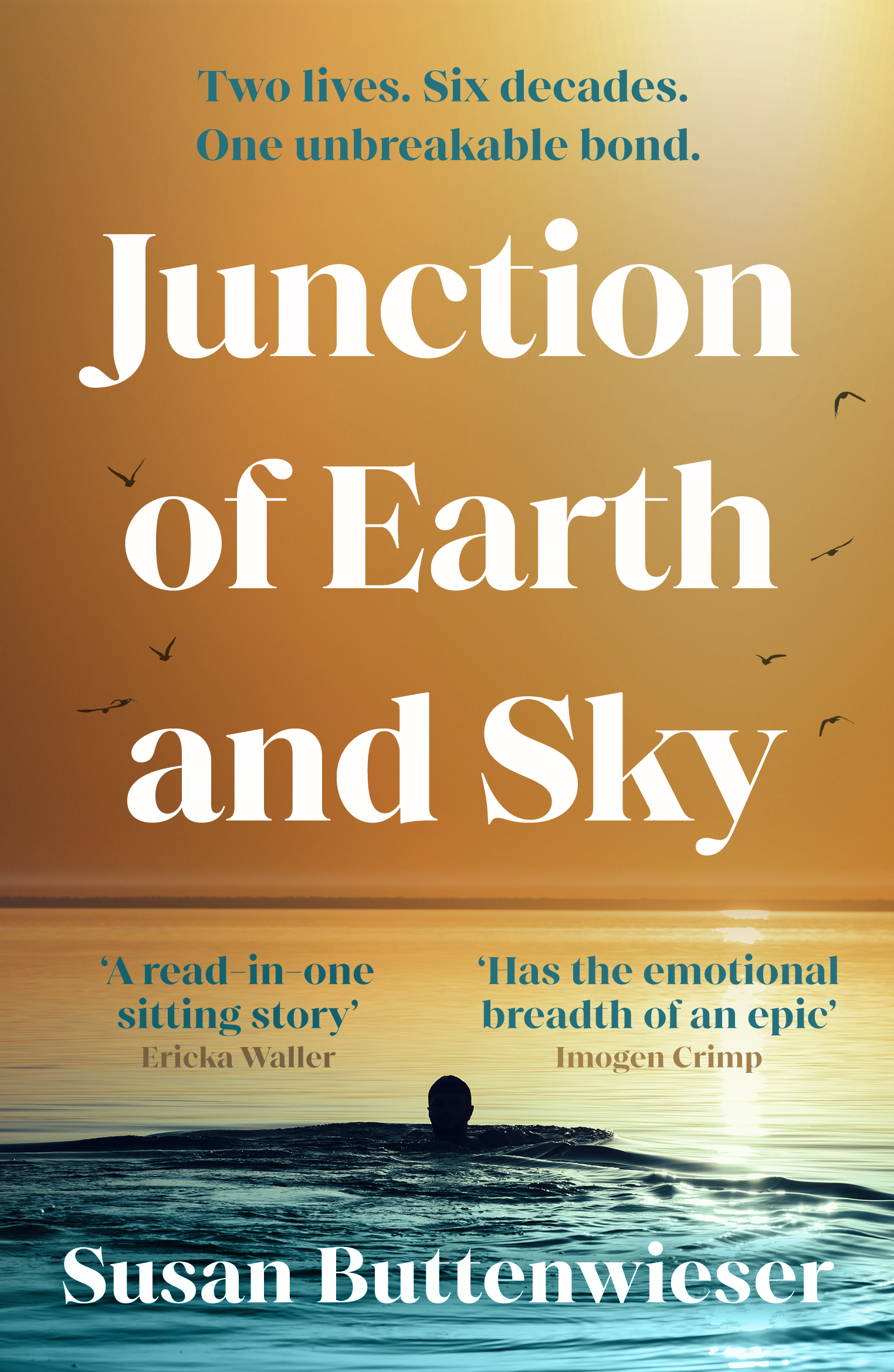
The events of Susan Buttenwieser’s debut novel, Junction of Earth and Sky, are set into motion by World War II, but this is not a typical World War II novel. Instead of epic battles, Buttenwieser lays bare the conflict and warfare of domesticity. In lieu of heroes forged from bravery, there are complete, flawed characters navigating everyday life, figuring out how to love and be loved. Readers of Kristin Hannah’s novels might enjoy this literary historical fiction and its multidimensional characters, Alice and her granddaughter, Marnie.
After the war upends teenage Alice’s life in coastal England, she makes her way to the United States—an ocean away from home and the life she’d imagined for herself. Fifty years later, Marnie traverses the New England coastline, delivering drugs with no foreseeable way out. Buttenwieser braids Alice’s and Marnie’s seemingly disparate stories together across three timelines, inviting the reader into Alice’s life in England in the 1940s, Marnie’s childhood in the 1970s and 1980s in New England, and Marnie’s young adulthood in the 1990s. The initial jump—from Marnie waiting for her boyfriend to rob a pharmacy in 1993 to Alice swimming along the southern coast of England in 1940—is abrupt, and the shifts across decades and continents are unrelenting throughout the novel. Nevertheless, Buttenwieser uses these continuous moves in time and perspective effectively; rather than disorienting the reader, they mimic the rhythm of tides, drawing the reader in and building tension before a new wave arrives via the next chapter.
The ebb and flow of the sea is not only salient in the structure of the novel, but the prose itself is anchored in a strong sense of place. While this is not a case of the setting becoming another character, the constant presence of the ocean is palpable. Always in the background, the Atlantic Ocean is a source of both pain and reprieve for Alice, something that separates her from her beloved home but bonds her to Marnie through their shared affinity for the sea. The water is Alice’s place of refuge as a child, and she brings Marnie to the beach often, including the day when Marnie’s mother moves out:
‘Nanny, the water looks spooky, don’t you think?’
‘Why’s that, then?’
‘It looks like something is going to leap out of it. How many things are in that water?’
‘So many. I can’t even imagine. A whole world under there and we only see the surface. Don’t we?’
‘Someday I want to see all of it. I want to see everything under there. Every single thing. Do you think I could? If I looked really carefully?’
Marnie looks up at her grandmother for an answer, but Alice is staring at the sea and doesn’t say anything. Gazing hard out over the calm, grey water. Maybe her granddaughter is right and it’s merely a matter of looking in just the right way. Maybe it is possible to see everything, even across to England. Home. (Buttenwieser 131)
Junction of Earth and Sky gives readers what Marnie asks for in this excerpt: the opportunity to peek beneath the surface of the characters’ lives and see everything. Buttenwieser, the author of a short story collection and recipient of a Pushcart Prize nomination, knows how to write characters in their full humanity—not only Alice and Marnie, but Marnie’s parents, Denise and Sonny, and Denise’s brother, Mike, among others. Like the ocean churning, crashing, and glistening in the distance, these characters contain multitudes: Denise shares tender moments with her daughter at a Red Sox game but ruins her daughter’s birthday party with selfish antics. Sonny is abusive and unreliable but aspires to take his daughter camping. And Alice struggles to raise Sonny but soars as a grandmother to Marnie: “She had never enjoyed Sonny the way she enjoys Marnie. He was so hard to manage and she was overwhelmed, looking after him all by herself, in this strange new country where she didn’t know anyone. Sometimes, in darker moments, she wished he had never been born” (44). Again, there are no heroes, just characters who are fully human, not easily pegged as likable or unlikable, but whole and complex.
Children of war and generational trauma, Buttenwieser’s characters hurt each other, but they also have the capacity to carry one another. Flawed and flailing, nearly drowning in their own failures, they kick to the surface in an attempt to find connection—an ever-moving target, much like the junction of Earth and sky.
Junction of Earth and Sky by Susan Buttenwieser
Manilla Press, 2024, 280 pages, £9.99 UK paperback
ISBN: 9781786583864
Melissa Kutsche lives in Michigan. She writes about midlife, motherhood, books, and other sacred/ordinary things. Read more on her website and Substack.