
Nettie Reynolds
Crossing the Canyon
In June 2011, a month after my divorce was finalized, I packed up the car in Austin, Texas, and took the first of what would become many trips with my two kids—my nine-year-old son, my eleven-year-old daughter—and our pug. We had always wanted to see the Grand Canyon, and that summer I decided: we would go. Just the three of us, finding a new path.
The Grand Canyon is still forming. The Colorado River didn’t carve it in one dramatic gesture—it shaped it slowly, over millions of years, with flood and drought, ice and heat. Families are like that too. We form, dissolve, shift, reform. Sometimes it’s one day—one decision—that begins a new shape.
In the background, life was unraveling in ways I couldn’t explain to my children. What they knew was that we were now a trio. What I knew was that we needed a beginning—something I could give them, even when so much felt beyond my control.
I also packed my grandfather’s old binoculars—the heavy black ones he used flying planes as a Major General in the Air Force. He had never met my kids, but I kept him alive through stories. He had taken me and my sisters on long summer road trips in his wood-paneled wagon, stopping at every roadside attraction worth a photo. Once, he drove us to Kitty Hawk so I could write a school report on the Wright Brothers with the Atlantic breeze in my face. Road trips were our family’s shared language. So bringing him along—if only through scratched lenses—felt like continuing the lineage.
We didn’t have a big budget, but we had a travel plan built from Food Network reruns. It was the kids’ idea—one vegetarian, one meat lover—to chart our meals by roadside diners we’d seen on TV. Our first stop was a Texas truck stop. My son devoured his steak with confidence. My daughter curated a baked potato the size of her head. I ordered a salad that barely filled a cereal bowl. We didn’t agree on food, but we shared the joy of eating together.
The South Rim—where we would eventually stand—was formed through uplift and erosion, floods and droughts, force and stillness. Families are shaped the same way. We are carved not just by conflict, but by joy. That summer, I began to understand that rebuilding didn’t have to be dramatic. Sometimes it looked like eating pie at a roadside diner with two kids who didn’t agree on toppings. These quiet, ordinary moments were slowly forming the shape of our new life—one layer at a time.
Around 1 a.m. on the first night of driving, I found myself alone at the wheel on a quiet stretch of desert highway, scanning signs for a motel that didn’t look haunted. The kids were asleep, curled under blankets. The pug snored softly between them. Outside, the world was black but for the blinking lights of distant 18-wheelers. I asked myself, not for the first time: Was I strong enough for this?
Then, from the backseat, my son’s voice. Soft. Tentative. Singing Leonard Cohen’s “Hallelujah”—the version from Shrek. I joined in. My daughter stirred, blinked awake, and added her voice too. And there we were: three voices in the dark, stitched together by a borrowed melody and the rhythm of tires on the road. I didn’t feel alone anymore.
When we finally arrived, the Grand Canyon opened before us like a curtain lifting on something vast. My daughter stood at the rim and whispered, “It doesn’t even look real.” We hiked. We stared into its ancient, rust-colored layers. I handed them my grandfather’s binoculars and they took turns peering into the canyon’s depths, calling out rock shelves and shadows. My children, seeing the canyon through their great-grandfather’s eyes. I felt generations braided together in the sun.
On our last morning, at sunrise, I hiked alone to Ooh-Aah Point—the first place on the South Kaibab Trail where the canyon unfurls in full glory. The name sounds silly until you round the bend and see it, and realize it’s the only thing you can say.
I reached into my pocket and pulled out my wedding ring. I had worn it through years of unraveling, through courtrooms and silences. Now it felt impossibly small. I took out a small green gardening trowel—a leftover from my daughter’s mini gardening set. The earth was soft from rain the day before, and the sunrise was just beginning to warm the canyon walls.
I kissed the ring. Whispered a thank you—to the canyon, to the moment, to whatever thread of grace had given me these two children and the strength to keep going. Then I knelt beneath a low juniper bush and dug a small hole. I placed the ring inside and covered it gently with the red soil, pressing a flat stone on top as a kind of marker.
Just a quiet act of letting go. By myself. At the edge of something ancient.
I hadn’t just crossed a canyon—I had crossed a life. I was no longer a wife and mother clinging to the shape of something broken. I was an independent woman and mother with two kids and a pug, standing on the other side.
We drove home the long way, stopping at pie shops and local diners, making it work one meal at a time. I watched my kids eat, laugh, argue about music—and I knew: this was working. Somehow, it was working.
That trip became the first of many. And every single one starts the same way: the three of us, windows down, singing “Hallelujah”—the song that reminds us we belong to each other, no matter the miles behind or ahead.
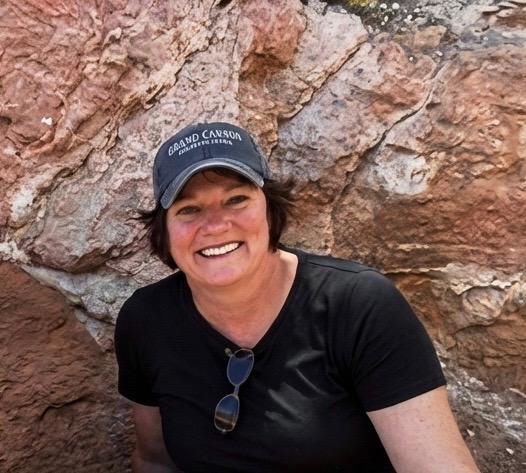 Nettie Reynolds is a Chicago-based essayist and playwright.